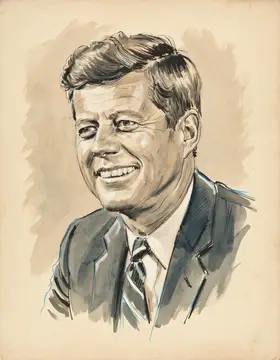
John F. Kennedy on Communism
TL;DR
John F. Kennedy strongly opposed global Communism, viewing it as a hostile political and military threat requiring firm containment and the active defense of liberty.
Key Points
He stated that Communism had never gained power in a nation not already disrupted by war or corruption, as stated in a 1963 address in Berlin.
As president, his foreign policy centered on containing the spread of Communism, which was codified in principles that expanded on prior doctrines.
He warned that the global struggle against Communism must be fought on many fronts, including ideological, economic, and military, as evidenced by his 1960 Senate speech.
Summary
John F. Kennedy consistently viewed Communism as the central international challenge to American ideals and global stability during his political career and presidency. His core position involved the containment of its spread, which he frequently articulated in speeches, stressing that the free world must actively resist Communist advances everywhere. This commitment was crystallized in his inaugural address, where he pledged to "pay any price, bear any burden" to assure the survival and success of liberty against foes. The Kennedy Doctrine specifically focused on containing Communist expansion, particularly in Latin America following the Cuban Revolution, aiming to foster democratic progress to undermine Communist appeal.
His administration's strategy balanced military strength with diplomatic and economic initiatives aimed at addressing the root causes of revolutionary appeal, such as poverty and tyranny. He believed that an active offensive for freedom, supported by a revitalized American economy and robust diplomacy, was necessary to win the Cold War ideological contest. The president's commitment to this confrontation was tested severely by events like the Berlin Crisis and the Cuban Missile Crisis, where his administration confronted Soviet aggression directly through calculated displays of strength.
Key Quotes
The most powerful single force in the world today is neither Communism nor Capitalism, neither the H-bomb nor the guided missile -- it is man's eternal desire to be free and independent.
Frequently Asked Questions
John F. Kennedy considered Communism a profound and hostile global threat to liberty that required firm and active opposition from the United States. According to his public statements, he believed the primary Cold War issue was the struggle between the free world and the Communist world. He pledged to meet any hardship to assure the success of freedom against this ideology.
The president championed the Kennedy Doctrine, which involved containing Communist influence, particularly in the Western Hemisphere following the Cuban Revolution. He pushed for the Alliance for Progress, an effort to foster economic and social development in Latin America to eliminate the conditions of poverty upon which Communism feeds, as outlined in his 1961 address. He was resolute in resisting further Communist encroachment in the region.
During the Cuban Missile Crisis in October 1962, Kennedy famously announced a naval quarantine of Cuba and warned of a full retaliatory response if the missiles were used. This firm stance, balanced with secret diplomacy, led to the Soviet withdrawal of the missiles. He also confronted the Soviets in Berlin by reinforcing the commitment to the city's freedom, as articulated in his 1963 speech there.
Sources8
JFK on Containment of Communism
Remarks at Rudolf Wilde Platz, Berlin, Germany
Kennedy Doctrine - Wikipedia
Excerpts of Speech by Senator John F. Kennedy, American Legion Convention, Miami Beach, FL - (Advance Release Text)
John F. Kennedy Quotes About Communism | A-Z Quotes
JFK and Communism | American Experience | Official Site | PBS
* This is not an exhaustive list of sources.