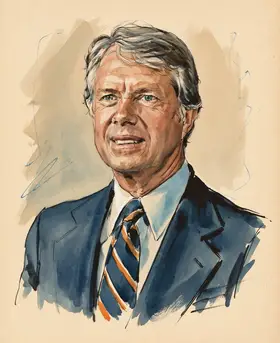
Jimmy Carter on Human Rights
TL;DR
Jimmy Carter made the promotion of universal individual human rights a central, explicit cornerstone of United States foreign policy.
Key Points
He made the United States signatory to the two U.N. Covenants on Human Rights in October 1977.
His administration mandated annual State Department human rights country reports for security and economic assistance recipients.
He championed the Refugee Act of 1980, which established a permanent, formalized U.S. refugee system.
Summary
James Earl Carter Jr. campaigned on and subsequently implemented a foreign policy strategy where human rights considerations were integral, aiming to infuse a new morality into American diplomacy. His core position, stated clearly in his inaugural address, was a “clear-cut preference for those societies which share with us an abiding respect for individual human rights,” grounding these principles in the Universal Declaration of Human Rights. This commitment was formalized through Presidential Directive 30, which linked economic and military assistance to the human rights records of recipient nations, while his administration also actively criticized abuses in nations like the Soviet Union, and supported dissidents worldwide.
While his focus on human rights was consistent with his personal beliefs, stemming partly from his experience with the Civil Rights movement, the practical application of the policy yielded mixed results and faced challenges balancing idealism with geopolitical realities. Critics often pointed to inconsistencies in applying pressure, such as toning down criticism of certain allies or strategic partners like Iran, leading to political pushback during his presidency. Nevertheless, the administration created institutional structures, such as the Bureau of Human Rights and Humanitarian Affairs, and supported landmark legislation like the Refugee Act of 1980, solidifying human rights as a permanent element of subsequent U.S. foreign policy discourse.
Key Quotes
we should not insist on identical governments or all nations of the world to accept our standards exactly. But we cannot look away when a government tortures its own people, or jails them for their beliefs, or denies minorities fair treatment, or the right to immigrate. Or the right to worship.
“Jimmy Carter brought the human rights movement into the halls of power and worked to create a government guided by human dignity,”
Frequently Asked Questions
The primary goal for Jimmy Carter was to make human rights a central and explicit cornerstone of United States foreign policy, emphasizing a moral dimension in international relations. He believed this involved promoting freedom worldwide and protecting individuals from arbitrary state power, according to his statements.
Implementation involved using the full range of diplomatic tools, including public statements criticizing violations and linking foreign aid—both economic and military—to a nation's human rights record. His administration also created the Bureau of Human Rights and Humanitarian Affairs within the State Department to manage this focus.
Yes, his human rights gambits often received mixed results and faced criticism for inconsistency, particularly regarding how he treated authoritarian allies versus adversaries. This political pushback sometimes forced him to balance human rights goals against other foreign policy objectives, such as arms control.
Sources7
Carter and Human Rights, 1977–1981
Jimmy Carter's Human Rights Legacy
Remembering Jimmy Carter's Legacy on Human Rights and Refugee Protection
Jimmy Carter: Foreign Affairs
President Jimmy Carter Remembered as Health Care and Human Rights Champion
Remarks on Human Rights at Notre Dame University in South Bend, Indiana
Carter Makes Human Rights a Central Theme of Foreign Policy
* This is not an exhaustive list of sources.