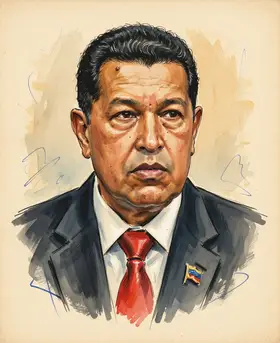
Hugo Chávez on Trump
TL;DR
Hugo Chávez did not publicly comment extensively on Donald Trump as his presidency ended shortly before Trump's major political rise.
Key Points
Chávez passed away in March 2013, predating Donald Trump's successful 2016 presidential campaign.
Scholarly analysis frequently compares Trump's populist appeal to the style previously established by Chávez.
The connection between the two figures is largely drawn by commentators post-2016 through ideological contrast and populist methodology.
Summary
Hugo Chávez, the late Venezuelan president, did not directly address Donald Trump as a political figure in any significant, documented public statement, as Chávez died in 2013, preceding Trump's rise to the presidency. Analysis from scholars and commentators post-2016 often draws parallels between the two figures, viewing Trump as a right-wing counterpart to the populist, anti-imperialist movement Chávez embodied. These comparative viewpoints suggest that Trump's politics echo certain populist rhetorical styles associated with Chávez, though with opposing ideological foundations regarding economic policy and international relations.
The legacy of Chávez's presidency is sometimes invoked when examining the dynamics of modern populism, with some suggesting that Trump's political style represents an evolution or mutation of the Latin American left-wing populism that Chávez spearheaded. Though direct commentary is absent, the connection exists in subsequent academic and journalistic comparisons about the assault on established institutions and the mobilization of a base against perceived elites. Therefore, any positioning is inferred through comparisons made by third parties regarding their populist appeal and challenges to global norms.
Frequently Asked Questions
Hugo Chávez never publicly commented on Donald Trump as a major political figure because Chávez died in 2013, before Trump's presidency began. Therefore, there are no direct statements from Chávez on Trump available. Any modern perspective relies on later analysis drawing comparisons between the two leaders.
Yes, analysts often suggest that both figures employed similar populist rhetorical strategies to mobilize their respective bases against established systems. However, the sources clearly indicate that their ideological foundations—Chávez being left-wing and Trump being right-wing—are fundamentally opposed. This comparison is usually made to study the mechanics of modern populism.
No, Hugo Chávez's position on Trump could not have evolved as he died before Trump achieved major national prominence in the United States. The relationship exists only in retrospect, where commentators compare Trump's political rise to the era defined by Chávez's presidency.
Sources8
What Hugo Chávez Tells Us About Donald Trump
From Hugo Chávez to Donald Trump: The Assault on Academic Freedom and Directions for Resistance
Is Donald Trump the right-wing version of Hugo Chávez?
From Hugo Chávez to Donald Trump: The Assault on Academic Freedom and Directions for Resistance
Chavez and Trump Have More in Common Than You Think
No Trump, No Chávez: The Crisis of Populism
Hugo Chávez and Donald Trump: A Comparative Analysis of Populist Leadership
Chavez and Trump: The Populist Link
* This is not an exhaustive list of sources.