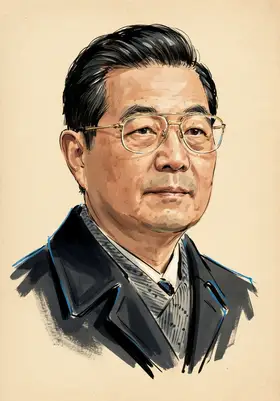
Hu Jintao on Political Ideology
TL;DR
Hu Jintao adapted core Marxist tenets by prioritizing 'scientific development' and a 'harmonious society' over strict dogma.
Key Points
In 2011, Hu Jintao explicitly stated that the basic tenets of Marxism are an irrefutable truth, but must be constantly enriched and developed as practice changes, never taken as dogma.
His key ideological addition, the "Scientific Outlook on Development," emphasized "putting people first" and creating a "harmonious society," which was written into the Chinese State Constitution in 2007.
Hu Jintao's ideological stance was seen by some scholars as subtly replacing socialist egalitarian principles with liberal capitalist values of 'social equity and justice' under the guise of his development theories.
Summary
Hu Jintao's political ideology centered on an evolution of established Marxist and Socialist tenets, which he codified as the "Scientific Outlook on Development" and the concept of a "harmonious society." This represented a continuation of the trend started by his predecessors, notably Deng Xiaoping and Jiang Zemin, who had already reinterpreted core ideology to justify market-oriented economic reforms and globalization, asserting that Marxism was not a dogma but must adapt to practice. During his tenure, Hu emphasized that development needed to be "scientific," "people-centered," and balanced, subtlely shifting the rhetorical focus from purely economic growth toward broader social equity and justice, though critics noted this still acquiesced to a capitalist economic transformation.
This ideological framework allowed the Chinese Communist Party to maintain political cohesion while navigating the socio-economic imbalances created by rapid marketization. Hu endorsed his predecessor's "Three Represents" theory, which allowed for the inclusion of private entrepreneurs into the Party, while adding his own focus on social issues and harmony. This continuous, incremental adaptation of the core ideology—termed "Socialism with Chinese characteristics”—served to legitimize the Party's continued rule by demonstrating its relevance and capacity to address complex societal challenges without abandoning its theoretical socialist roots, despite the increasing divergence from classical Marxist principles.
Frequently Asked Questions
Hu Jintao's primary ideological contribution was the 'Scientific Outlook on Development,' which served as an evolution of 'Socialism with Chinese Characteristics' during his time as paramount leader. According to analysis of his speeches, he maintained fidelity to the foundation of Marxism while arguing that it must be constantly adapted to current practical conditions, not treated as a rigid dogma (cite: 1.4, 1.5).
No, Hu Jintao continued the path of market reform and economic development established by his predecessors. His ideological emphasis on a 'harmonious society' was interpreted as a subtle shift toward social equity rather than a reversal of the market economy, which he was instrumental in advancing (cite: 1.4, 1.5).
Hu Jintao built upon Jiang Zemin's 'Three Represents' theory, which opened the Party to entrepreneurs, by adding his own focus. While Jiang stressed the representation of advanced productive forces, Hu highlighted the representation of the most fundamental popular interests and called for 'scientific development' (cite: 1.5).
Sources4
China under Hu Jintao - Hoover Institution
Chinese Political Rhetoric and Ideology: Tension and Pretension
The Communist Party of China and Ideology - Brill
The Politics of Reform in China: Deng, Jiang and Hu
* This is not an exhaustive list of sources.