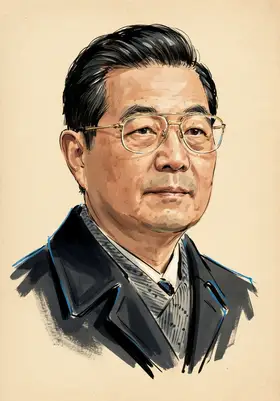
Hu Jintao on Economic Policy
TL;DR
Hu Jintao pursued pragmatic economic policies focused on stabilizing growth, reducing regional inequality, and managing environmental fallout.
Key Points
He guided China through the global financial crisis, ensuring the economy avoided recession, though stimulus heavily favored real estate lending.
In 2005, he initiated a partial float of the yuan and oversaw a larger upward revaluation in 2010 to address trade imbalances.
His administration implemented policies aimed at reducing regional disparities, including rural infrastructure investment and tax cuts for farmers.
Summary
Hu Jintao’s economic policy during his tenure aimed primarily at stability and addressing acute imbalances generated by the preceding rapid growth, which was amplified by China's 2001 WTO accession. He vigorously addressed soaring regional disparities through initiatives like building rural infrastructure, supporting rural businesses, enacting land reform, improving rural healthcare, and cutting farmers' taxes, which research suggests helped decline regional inequality. He also oversaw modest environmental improvements in major cities, despite the overall pollution challenge remaining significant, as evidenced by pollution data from the mid-2000s.
He steered the economy through the global financial crisis without a recession, partly by coordinating macro economic policies internationally, but his domestic stimulus relied heavily on bank lending to real estate, which a trusted advisor noted later caused productivity growth to slow down. A key feature was managing the currency; he partially floated the yuan in 2005 and allowed a larger revaluation in 2010 to temper trade imbalances. His preference was for a dual-pillar system where State-Owned Enterprises maintained stability and infrastructure while Private-Owned Enterprises drove profits and innovation, contrasting with the increased state control seen later.
Key Quotes
China will continue to steadily advance the reform of the formation mechanism of the RMB exchange rate under the principle of independent decision-making, controllability and gradual progress.
Frequently Asked Questions
Hu Jintao's main economic goal, as assessed by observers, was focused on stability and skillfully managing the challenges arising from rapid growth. He prioritized tackling issues like regional economic inequality and environmental degradation that resulted from earlier liberalization phases, according to commentary on his tenure.
Hu Jintao managed the currency by moving away from a fixed peg; he partially floated the yuan in 2005, allowing it to begin a gentle rise. A more significant upward revaluation occurred in 2010, a move intended to help balance China's trade surplus, as detailed in historical timelines.
During the Hu Jintao era, the economic model generally involved a dual structure where State-Owned Enterprises were tasked with economic stability and infrastructure support, while Private-Owned Enterprises were expected to pursue profits, innovation, and job creation, according to analysis of the period.
Sources9
Hu Jintao was very underrated
President Hu Jintao's Visit: The Economic Challenges and Opportunities | Brookings
President Hu to voice stance on climate change, economic recovery, security at UN, G20 summits
Strategic and Economic Dialogue Opening Session (Complete Remarks)
Overcoming the Great Recession: Lessons from China | Harvard Kennedy School
Xi's policies serve strategic national goals beyond growth | Merics
Fact Sheet Creation of the U.S.-China Strategic Economic Dialogue | U.S. Department of the Treasury
Hu Jintao and Contentions over the Rise of China - ResearchGate
What assessment do we make of Hu Jintao, the president before Xi Xingping? : r/Socialism_101
* This is not an exhaustive list of sources.