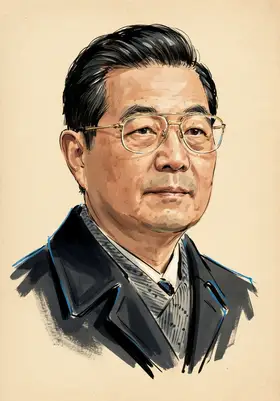
Hu Jintao on Barack Obama
TL;DR
Hu Jintao viewed the relationship with Barack Obama as essential for global stability, advocating for pragmatic cooperation based on mutual respect.
Key Points
He welcomed the progress in bilateral ties following their meeting in Toronto in June 2010, stressing continued macroeconomic policy coordination and opposing trade protectionism by the U.S..
During a January 2011 press conference, he agreed with the president on the need to work together to tackle global challenges like financial crisis and terrorism, based on mutual respect.
In a March 2012 meeting in Seoul, he emphasized maintaining the cooperative partnership based on mutual respect and mutual benefit, while urging the U.S. to respect China's core interests and major concerns.
Summary
Hu Jintao, as China's paramount leader, consistently pursued a relationship with Barack Obama characterized by a "positive, cooperative, and comprehensive" framework, as affirmed in joint statements following meetings in 2009, 2010, and 2011. The core position emphasized that cooperation between the two nations was vital for addressing shared global challenges such as economic recovery, climate change, and nonproliferation, requiring both sides to operate in a spirit of being "in the same boat". While stressing the need to uphold the one-China policy and respect China's core interests, including sovereignty, Hu generally endorsed the progress made in high-level dialogues, like the Strategic and Economic Dialogue, designed to manage differences constructively.
The relationship was framed by Hu as a necessary mechanism for world peace and prosperity, with leaders agreeing to institutionalize high-level contact and expand military-to-military and people-to-people exchanges. Discussions often involved balancing areas of disagreement, such as human rights and trade imbalances, with areas of mutual interest. Hu's stance reflected a pragmatic approach to maintaining stable, high-level engagement with the U.S. president to ensure China's continued development was not destabilized by friction, while also positioning China as a responsible global actor.
Key Quotes
China is willing to work with the U.S. side for the future and strive for new progress in China-U.S. cooperative partnership in order to bring greater benefits to the two peoples as well as people of the world
Frequently Asked Questions
Hu Jintao generally viewed his relationship with Barack Obama as vital for global stability and sought to advance it as a positive, cooperative, and comprehensive partnership, according to joint statements. He believed this relationship was necessary for tackling major international issues and required mutual respect between the two nations. He consistently appreciated the engagement through mechanisms like the Strategic and Economic Dialogue.
Hu Jintao maintained that China respected the universality of human rights but stressed the need to consider China's specific national circumstances as a developing country. He affirmed China's willingness to engage in dialogue on human rights with the U.S. on the basis of mutual respect and noninterference in internal affairs to increase understanding. On sovereignty issues like Taiwan, he emphasized the need for the U.S. to honor commitments.
The Chinese leader characterized the economic cooperation as mutually beneficial, noting that agreements signed during visits injected momentum for job creation in both countries. He stressed that trade frictions should be resolved through dialogue on an equal footing. Furthermore, Hu pointed out that the RMB exchange rate was not the cause of U.S. structural economic problems, despite U.S. calls for appreciation.
Sources6
The President's News Conference With President Hu Jintao of China
Hu and Obama: What Did It All Mean?
Hu Jintao Meets with U.S. President Obama
President Hu Jintao Meets with US President
Hu Jintao Meets with US President Obama
U.S.-China Joint Statement
* This is not an exhaustive list of sources.