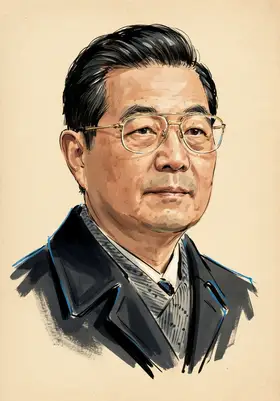
Hu Jintao on Leadership
TL;DR
Hu Jintao prioritized collective leadership and consensus-based rule while emphasizing the Party's supreme authority and stability.
Key Points
He retired voluntarily from all positions, including General Secretary (2012) and Chairman of the Central Military Commission (2012).
He introduced the 'Scientific Outlook on Development' as an ideological framework guiding domestic policy toward a 'Harmonious Socialist Society'.
In a January 2012 New Year's speech, Hu Jintao stressed the need to uphold the Party’s core leadership position.
Summary
Hu Jintao's approach to leadership was characterized by an emphasis on collective rule and consensus-based decision-making within the Politburo Standing Committee, a system sometimes described as 'nine dragons taming the water.' He was notably less personalistic than his predecessor and successor, adhering to institutional norms like term limits and voluntary retirement from all top posts by 2013, which provided a period of predictable leadership succession. However, his leadership style also led to criticisms of inaction and poor policy coordination due to a reluctance among the oligarchy to challenge one another's domain interests.
This period of collective leadership was framed by Hu's core domestic philosophy, the Scientific Outlook on Development, aimed at creating a 'Harmonious Socialist Society.' In the military, his leadership introduced 'new historic missions' derived from this concept, integrating them into the PLA's strategic guidance. The overall tenure of Hu Jintao is often viewed in retrospect as a technocratic, low-profile management phase that was dedicated to maintaining social stability for continued economic growth.
Frequently Asked Questions
Hu Jintao's leadership was primarily defined by a commitment to collective leadership and consensus-based decision-making among the Politburo Standing Committee members, according to analyses of his tenure. This style contrasts with the more personalistic rule seen before and after his time in office. His approach aimed to prevent the over-concentration of power in a single individual.
Yes, Hu Jintao formalized his political philosophy through the Scientific Outlook on Development, which was written into the CCP and State Constitutions in 2007 and 2008, respectively. This concept served as the ideological basis for his leadership and his 'Harmonious Socialist Society' goal. Furthermore, his introduction of 'new historic missions' for the military redefined its orientation under his command.
Hu Jintao was praised for adhering to the established norms for leadership succession by voluntarily retiring from his top posts, setting a precedent for peaceful transition, as noted in historical accounts. This act contrasted with later leadership trends, demonstrating his commitment to institutionalized turnover at the apex of power. He was succeeded by Xi Jinping in 2012 and 2013.
Sources7
Chairman Hu and the PLA's “New Historic Missions”
The Last Year of Hu's Leadership: Hu's to Blame? | Brookings
Hu Jintao was very underrated
China in Xi’s “New Era”: The Return to Personalistic Rule | Journal of Democracy
Hu Jintao - Wikipedia
Hu Jintao Stresses the Party’s Core Leadership Position – Chinascope
Full Text of Hu Jintao's Report at 18th CPC Party Congress
* This is not an exhaustive list of sources.