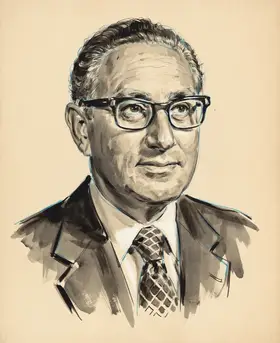
Henry Kissinger on Palestine
TL;DR
Henry Kissinger pursued a strategy of step-by-step diplomacy to deal with Arab states while actively working to isolate the Palestinian national movement.
Key Points
He considered the West Bank and Jerusalem to be primarily Israel's problems, not the United States' concern, during his active diplomacy era.
In a 1975 meeting, he told Iraqi leaders that while he could not negotiate Israel's existence, the US could aim to "reduce its size to historical proportions."
He admitted to a group of Jewish leaders that his approach of 'one step at a time' for the Israeli-Palestinian conflict might have led to the opposite result of what was intended, as settlement populations grew post-1976.
Summary
Henry Kissinger's approach to the Israeli-Palestinian conflict during his tenure as Secretary of State was characterized by a strategic focus on balancing regional powers and containing Soviet influence, often prioritizing bilateral deals with Arab states over directly addressing core Palestinian national claims. He was explicit in his desire to exclude the Palestine Liberation Organization (PLO) from negotiations, believing that engaging them would radicalize the process by forcing the introduction of issues Israel could not handle, such as final status issues. Kissinger’s preferred path was incremental progress with Egypt and Syria, shifting the focus from 'land for peace' to 'land for time,' which he believed would allow Israel to build strength while delaying intractable political solutions regarding the West Bank. [cite:3, cite:5]
This strategy also involved prioritizing the 'Jordanian option,' which aimed to restore Jordanian control over parts of the West Bank, explicitly to prevent the PLO from gaining a foothold there. Critics note that this focus on isolating the Palestinians contributed to a nineteen-year impasse on West Bank negotiations and a significant increase in Israeli settlement populations after his departure. Although Kissinger later stated his preferred solution involved a 'Palestinian state-in-the-making' with provisional borders, his contemporary actions focused on managing the conflict through disengagement agreements, as evidenced by his private discussions where he prioritized Egyptian and Syrian agreements over Palestinian inclusion. [cite:2, cite:8]
Key Quotes
I think the Palestinian identity has to be recognized in some form. But we need the thoughtful cooperation of the Arabs. It will take a year or a year and a half to do it and will be a tremendous fight. An evolution is already taking place.
Frequently Asked Questions
Henry Kissinger's main tactical goal was to isolate the Palestine Liberation Organization (PLO) from the negotiating process, according to accounts of his tenure. He believed that involving the PLO would complicate matters by bringing up issues that Israel was unwilling to discuss at the time. This position is highlighted in memoranda from his meetings with various leaders. [cite:3, cite:5]
In conversations analyzed by historians, Henry Kissinger indicated he favored building a "Palestinian state-in-the-making," one step at a time, with provisional borders. However, his practical diplomacy was focused on interim agreements with Arab states like Egypt and Syria, often while intentionally bypassing or obstructing a role for the Palestinians. [cite:2, cite:9]
Kissinger viewed the conflict largely through the prism of Cold War great power politics, aiming to frustrate Soviet influence in the Arab world. He asserted to Arab leaders that the survival of Israel was important, but he also stated that an overly strong Israel was detrimental to broader US interests in securing alliances with Arab states. [cite:5, cite:9]
Sources7
The Middle East according to Kissinger | INSS
Kissinger: Years of Renewal | Institute for Palestine Studies
Henry Kissinger and his original sins of US Middle East policy
Foreign Relations of the United States, 1969–1976, Volume XXV, Arab-Israeli Crisis and War, 1973 Document 398
Kissinger Memorandum: "To Isolate the Palestinians"
Henry Kissinger to Iraq in 1975: “We Can Reduce Israel's Size”
Master of the Game: Henry Kissinger and the Art of Middle East Diplomacy - Indyk by Jensehaugen
* This is not an exhaustive list of sources.