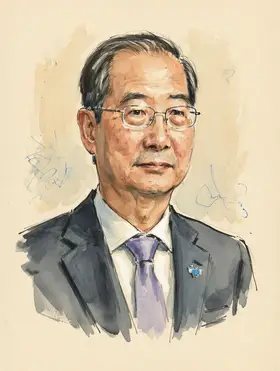
Han Duck-soo on Judges
TL;DR
Han Duck-soo's position on judges is framed by his criminal conviction and subsequent appeal regarding the December 3 martial law.
Key Points
The former Prime Minister received a 23-year prison sentence in January 2026 for charges related to participating in important duties of the December 3 martial law insurrection.
Han Duck-soo contested his conviction at the Seoul High Court's first appeal hearing in March 2026, arguing he only attempted to dissuade the declaration.
As acting president, he was accused of obstructing justice for refusing to appoint three Constitutional Court judges without bipartisan consent, leading to an impeachment motion in December 2024.
Summary
Han Duck-soo's stance regarding the judiciary is not explicitly stated as a general policy but is heavily defined by his direct interaction with the courts, specifically his conviction for insurrection related to the December 3 martial law declaration. He received a 23-year prison sentence from the Seoul Central District Court for participating in key insurrection duties, a ruling he has since contested in an appeal hearing in early 2026. The court's judgment characterized the martial law declaration as an insurrection and 'effectively a palace coup,' suggesting a judicial finding against the actions Han was involved in while serving as Prime Minister.
Contextually, Han's role involved judicial appointments, as the acting president, where his refusal to appoint Constitutional Court judges without bipartisan consent led to an impeachment motion against him by the opposition party. His argument was that an acting president should refrain from exercising significant powers like appointments to constitutional institutions without consensus, prioritizing stability. This action highlighted a conflict between maintaining judicial capacity and respecting the political scope of an acting leader, setting up a critical confrontation with the legislature over judicial appointments.
Key Quotes
... there was no participation in a riot for the purpose of subverting the constitutional order.
Frequently Asked Questions
Han Duck-soo's position is primarily demonstrated through his legal context, as he was convicted by a judge for actions taken while in office, according to reports from January 2026. His defense argued that he tried to dissuade the unconstitutional declaration, as detailed in his appeal proceedings.
Yes, Han Duck-soo faced impeachment proceedings in late 2024 precisely because he was reluctant to formally appoint three Constitutional Court justices without reaching a compromise with the opposition party, as reported by Al Jazeera. He stated that an acting president should refrain from such significant appointments, according to his argument at the time.
The presiding judge in Han Duck-soo's initial sentencing hearing declared that the December 3 martial law was an insurrection and described it as "effectively a palace coup," as detailed in reports from January 2026. The judge maintained an uncompromising stance throughout the sentencing and ordered his immediate detention.
Sources7
Acting president faces backlash over Constitutional Court appointments
Han Duck-soo Stands Frozen as Judge Delivers 23-Year Sentence for Insurrection
Han Duck-soo contests insurrection verdict at Seoul appeal hearing
Crime of judicial distortion could distort judicial conscience
South Korea's opposition files motion to impeach acting president
South Korea acting president to move quickly to fill Constitutional Court vacancies amid political turmoil
Editorial: When a mature democracy judges itself
* This is not an exhaustive list of sources.