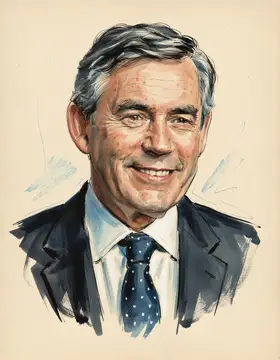
Gordon Brown on Political Reform
TL;DR
Gordon Brown strongly advocates for extensive political reform to decentralize power and enhance integrity in British governance.
Key Points
He chaired the Commission on the UK's Future, which proposed transferring responsibilities like job centres and education colleges to local control to boost regional economies as of December 2022.
His reform package includes proposals for a statutory code of conduct for MPs and an ethics and integrity commission to address public trust issues following scandals.
A campaign led by him in June 2023 recommended abolishing the House of Lords and establishing an elected 'assembly of the nations and regions'.
Summary
Gordon Brown is a vocal proponent of significant political reform, asserting that it is a necessity for building economic prosperity and alleviating poverty across the United Kingdom. He argues that the current system suffers from an over-concentration of power in Westminster and Whitehall, which alienates millions of citizens who feel ignored. His core position, articulated through his Commission on the UK's Future, centers on devolving effective economic and social powers closer to the people in the regions and nations, directly linking political and economic renewal.
This reform agenda extends beyond mere devolution to include a substantial clean-up of public life and the modernization of central government institutions. He proposed replacing the House of Lords with an elected assembly of the nations and regions and implementing stronger anti-corruption measures, such as banning MPs' second jobs and establishing an ethics commission. While he was criticized for his historical stance on electoral reform while in office, his later advocacy suggests an evolution toward supporting more radical constitutional change to tackle entrenched issues.
Frequently Asked Questions
Gordon Brown's core position is that deep political reform is essential for the UK's future success, particularly for achieving economic prosperity across all regions. He believes the current centralization of power is a primary obstacle that must be addressed through constitutional change. He advocates for transferring power downwards and outwards from Westminster.
He has strongly supported replacing the House of Lords with an elected assembly representing the nations and regions of the UK. Furthermore, he has called for an end to perceived corruption by demanding an anti-corruption agency and banning second jobs for Members of Parliament.
No, his stance has been viewed by some critics as evolving, particularly regarding electoral reform. While he was reportedly a major opponent of reform while serving as Prime Minister, he later became a leading figure advocating for a new political settlement after leaving office.
Sources8
Think our plan to fix British politics is a pipe dream? Think again
Gordon Brown: what I believe
Britain's Brown Eyes Political Change
UK senior politicians launch campaign for constitutional reform
To save the UK's battered reputation for good governance, the government needs to go big on political reform
Can Labour's plans for constitutional reform deliver a “new politics”? | LSE British Politics
Brown's Blues: Britain's PM on Borrowed Time | TIME
Brown’s Cynical Deathbed Conversion To Electoral Reform - TRG
* This is not an exhaustive list of sources.