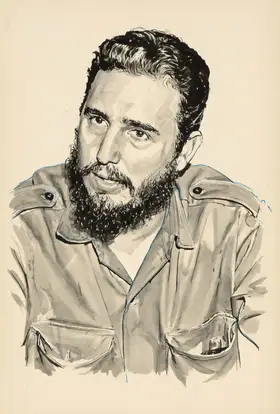
Fidel Castro on Violence
TL;DR
Fidel Castro viewed violence as a necessary tool for revolutionary struggle but condemned its use by foreign powers against sovereign states.
Key Points
He participated in an armed invasion in the Dominican Republic at age 20 and helped organize deadly riots in Colombia.
In January 1966, he insisted at the Tricontinental Conference that armed revolutionary struggle was the necessary path to power.
He justified post-1959 executions by asserting that revolutionary justice was based on moral conviction, not legal precepts, against murderers.
Summary
Fidel Castro held a dualistic position regarding violence, fundamentally viewing it as the essential path for revolutionary overthrow of oppressive regimes. Early in his career, he insisted that bullets, not ballots, were the correct mechanism for achieving power, even criticizing some Communist leaders who opposed armed struggle as deviationists. Following his 1959 revolution, he initially defended the subsequent violence, stating that "Revolutionary justice is not based on legal precepts, but on moral conviction" and was directed only at murderers. Despite initial promises of liberty, his administration was characterized by systematic repression and executions of opponents, which he framed as necessary for survival against internal enemies and external threats, such as US-sponsored terrorism.
Throughout his later tenure, Fidel Castro's stance shifted to vehemently condemning violence and force used by external actors, particularly the United States, against sovereign nations. He repeatedly urged the United States to respect the sovereignty of other countries and stop "using violence to loot other countries." Furthermore, his government provided material, training, and sanctuary to various international revolutionary, guerrilla, and terrorist groups, including the FARC, ETA, and the PLO, framing this support as solidarity against imperialism, thus actively propagating violence abroad while justifying his domestic actions as defensive or revolutionary necessity.
Key Quotes
"using violence to loot other countries"
Frequently Asked Questions
Fidel Castro strongly believed that violence was an indispensable component of revolutionary struggle to overthrow what he deemed oppressive regimes. According to historical records from his early career, he maintained that 'bullets not ballots' was the way to achieve political power. However, he also condemned the use of force by powerful states against smaller nations, as noted in a 2010 broadcast.
Yes, Fidel Castro actively supported and provided training and aid to various international revolutionary and guerrilla groups. His government offered sanctuary and assistance to organizations such as the FARC, ETA, and the PLO, framing this support as anti-imperialist action. This external promotion of armed struggle contrasts with his justification of domestic actions after the 1959 revolution.
After the 1959 revolution, Fidel Castro defended the subsequent trials and executions of opponents by arguing that revolutionary justice operated on a different moral basis than conventional law. He told reporters that they were not executing innocent people or political opponents, but rather murderers who deserved the consequence. This justification was noted in human rights documentation following his rise to power.