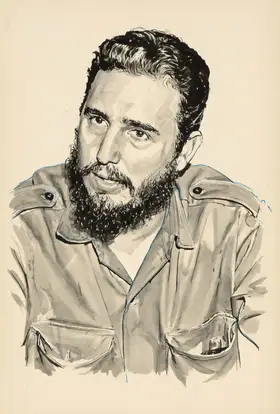
Fidel Castro on Revolution
TL;DR
Fidel Castro viewed revolution as a necessary, ongoing struggle between the future and the past, demanding total commitment.
Key Points
He stated that a revolution is a struggle to the death between the future and the past in 1959.
He defined Revolution in 2000 as encompassing full equality, freedom, and challenging powerful dominant forces within and outside national spheres.
Following the overthrow of Batista, he warned that the revolutionaries themselves posed the greatest potential future threat to the Revolution.
Summary
Fidel Castro consistently framed the concept of Revolution as a profound ideological struggle, defining it on May 1, 2000, as "a sense of the historical moment; it is to change everything that must be changed." He articulated that a genuine revolution transcends particular epochs and is a projection toward a future characterized by full equality, freedom, and human dignity for all, contrasting it sharply with bourgeois or colonialist movements. His early commitment, evidenced by the 1953 Moncada Barracks attack, showed his belief that even a small, faithful group could spark a massive transformation, stating that revolution is a struggle to the death between the future and the past.
His position evolved over time, moving from an initial focus on overthrowing tyranny and establishing democracy to embracing socialism as the definitive framework for achieving the revolution's deeper social justice goals. This evolution involved adopting Marxist-Leninist thought while simultaneously asserting the need for a Cuban-specific praxis, rejecting imported dogmas that did not fit the Caribbean reality. Furthermore, after the initial victory, Castro warned that the greatest future enemies of the Revolution would be the revolutionaries themselves if they succumbed to ambition or complacency, emphasizing that the people, not leaders, were the true victors and the ultimate guarantors of the revolutionary project.
Frequently Asked Questions
According to a key conceptualization, Fidel Castro defined Revolution as embodying "a sense of the historical moment" and the imperative "to change everything that must be changed." He framed it as a holistic concept that includes achieving full equality, freedom, and self-emancipation, according to analysis from Granma in 2025. This contrasts it with self-serving or bourgeois movements.
Fidel Castro asserted that revolutions are not exported, but rather are made by the people in their own context, as stated in his quotes. However, his government actively supported and supplied revolutionary movements abroad, which was viewed as 'exporting' the Cuban example to other nations against imperialism. This policy was influenced heavily by his associate, Che Guevara, during the 1960s.
Fidel Castro directly cautioned that "A revolution is not a bed of roses," emphasizing the constant struggle involved. In his January 1959 address upon entering Havana, he warned against over-optimism, stating that everything might become more difficult after the initial victory over tyranny.
Sources8
Cuban Revolution - Wikipedia
Quotes by Fidel Castro (Author of My Life) - Goodreads
Fidel Castro and the concept of Revolution, a look 25 years later › Cuba › Granma - Official voice of the PCC
'A revolution is not a bed of roses': Fidel Castro in his own words | Fidel Castro | The Guardian
Address Speech by Commander-In-Chief Fidel Castro on his arrival in Havana on 8 January 1959
Fidel Castro and the Cuban Revolution
FIDEL CASTRO AND THE CUBAN REVOLUTION: THE FIRST DECADE
Fidel Castro, Hero or Tyrant? | Baker Institute
* This is not an exhaustive list of sources.