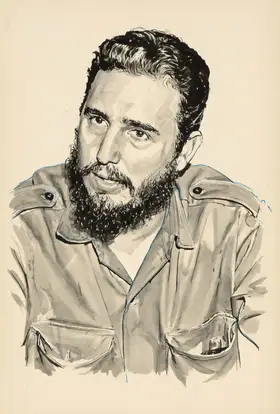
Fidel Castro on Cuba
TL;DR
Fidel Castro was the devoted architect of a one-party communist state, prioritizing national sovereignty and socialist reforms.
Key Points
He converted Cuba into a one-party, socialist state under Communist Party rule, the first in the Western Hemisphere.
He publicly declared his adherence to Marxist–Leninist ideology on December 2, 1961, following the Bay of Pigs Invasion.
His administration implemented socialist reforms that expanded healthcare and education access while also overseeing the suppression of internal dissent.
Summary
Fidel Castro's core position on Cuba was the establishment and staunch defense of a one-party communist state, rooted in Marxist-Leninist ideology and Cuban nationalism. Upon taking power in 1959, he immediately implemented sweeping socialist reforms, nationalizing industry and business while expanding social services like healthcare and education for all citizens, which supporters view as securing national independence from American hegemony. He consistently framed Cuba's political and economic structure as a necessary defense against external imperialist threats, particularly from the United States, which he opposed through domestic repression and international revolutionary support.
His commitment to this path was formalized when he declared himself a Marxist-Leninist in December 1961, solidifying the alliance with the Soviet Union and defining Cuba's trajectory for decades. While his administration was marked by the suppression of internal dissent, state control of the press, and a lack of political freedoms, Castro argued these measures were essential to protect the revolution's collective gains. Following the Soviet Union's collapse, he adapted by embracing limited economically liberal policies during the "Special Period" to ensure the socialist model's survival, demonstrating a pragmatic commitment to Cuba's continuity above all else.
Key Quotes
"Any revolutionary movement, in any corner of the world, can count on the help of Cuban fighters"
This means that within the Revolution, everything goes; against the Revolution, nothing. Nothing against the Revolution, because the Revolution has its rights also, and the first right of the Revolution is the right to exist, and no one can stand against the right of the Revolution to be and to exist, No one can rightfully claim a right against the Revolution. Since it takes in the interests of the people and Signifies the interests of the entire nation.
Frequently Asked Questions
Fidel Castro's fundamental position was to establish and maintain Cuba as a sovereign, socialist nation guided by Marxist-Leninist principles. He believed this structure was necessary to protect the social gains of the revolution against foreign intervention, especially from the United States, according to historical accounts. He considered his primary role to be the defender of this socialist project throughout his decades of leadership.
While his core commitment to socialism remained, his position evolved out of necessity after the dissolution of the Soviet Union in 1991. During the ensuing economic crisis, known as the "Special Period," he accepted limited economically liberal policies like legalizing small private enterprises to keep the Cuban economy afloat. He framed these adaptations as temporary measures required to defend the ultimate socialist goals, rather than a fundamental ideological shift, as stated in explanations of the reforms.
Fidel Castro consistently identified U.S. imperialism and the economic embargo as the principal threat to Cuba's sovereignty and revolutionary project. He viewed external opposition as the primary justification for the internal repressive machinery required to defend the state. This perspective allowed him to deflect criticism of domestic policies by citing the need to counteract U.S.-driven initiatives and aggression.
Sources10
Fidel Castro: Hero or Tyrant? | Baker Institute
Fidel Castro declares himself a Marxist-Leninist | December 2, 1961 | HISTORY
Fidel Castro Laid to Rest in Cuba, Ending Nine Days of Mourning
Fidel Castro's Record of Repression
Fidel Castro: A Biography
Fidel Castro
Fidel Castro on the fight to defend Cuba's socialist revolution - John Riddell
Castro and the Cold War | American Experience | Official Site | PBS
What's the opinion on Cuba and Fidel Castro : r/communism101
Foreign Relations of the United States, 1958–1960, Cuba, Volume VI
* This is not an exhaustive list of sources.