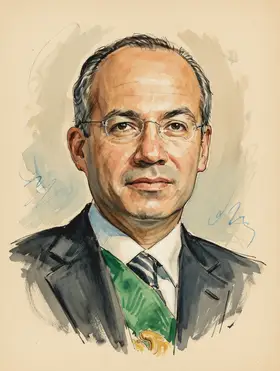
Felipe Calderón on Neoliberalism
TL;DR
Felipe Calderón views the free market as essential for economic growth but believes the state must intervene to ensure equal conditions for all citizens.
Key Points
He declared in 2007 that he was not a neoliberal, despite the market-oriented policies of his party.
His administration took office following a narrow 2006 election result and immediately initiated a major offensive against drug cartels, increasing public spending for security by 25 percent.
Calderón sought to create preconditions for investment by improving education, healthcare, and infrastructure, aiming to reduce inequality.
Summary
Felipe Calderón expressed that he is not a neoliberal, though he fundamentally supports the free market as a necessary condition for economic growth in Mexico. He argued that solely relying on the free market is insufficient, asserting that the state has a crucial role in creating equal conditions for everyone in society. His administration's focus was placed on attracting private investment to lower production costs and create jobs, which required establishing legal certainty and curbing crime, aligning with market-oriented principles while also attempting public policy interventions to address inequality.
His vision for Mexico's future, articulated in 2007, involved strengthening democracy, the rule of law, and economic competitiveness, contrasting this with what he termed a return to state-controlled systems and irresponsible economic policy seen in some other Latin American countries. He also emphasized reorienting foreign policy to reduce dependence on the United States, using Mexico's geographic position as an interface between North and South America to its advantage. His administration notably increased public spending for security as part of this economic strategy, a move criticized by opponents as an embrace of forceful imposition of policy.
Frequently Asked Questions
Felipe Calderón stated that he does not consider himself a neoliberal, but rather a centrist politician. He maintained that the free market is a fundamental condition for economic growth but stressed that the state must actively intervene to create equality of opportunity for all citizens.
He did not explicitly state that neoliberalism had failed entirely. Instead, he contrasted his approach with what he called an irresponsible economic policy and a return to state-controlled systems, suggesting his path of strengthening democracy and market competitiveness was the correct future for Mexico.
He believed the state's role was to create equal conditions for everyone and to establish legal certainty to attract necessary investment. This required curbing crime, as he deployed the military in a major offensive against drug trafficking shortly after taking office in 2006.
Sources9
Mexico after the Elections: The Crisis of Legitimacy and ...
Mexico and the Fourth Transformation
Three Decades of Neoliberalism in Mexico
SPIEGEL Interview with Mexican President Felipe Calderón: Build Roads, Not Walls
AMLO Goes Full Throttle Against Neoliberalism
FELIPE CALDERÓN: A COLLABORATOR AGAINST MEXICO
Neoliberal Reform and Cartel Ascendancy in Rural Mexico
Three Decades of Neoliberalism in Mexico
Working Paper No. 53, Mexico Under Neoliberalism
* This is not an exhaustive list of sources.