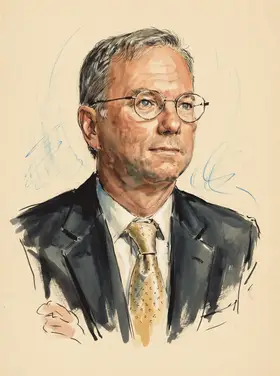
Eric Schmidt on AI Revolution
TL;DR
Eric Schmidt firmly believes the ongoing AI revolution is significantly underhyped compared to its monumental, world-changing impact.
Key Points
The arrival of this intelligence, spanning AGI to superintelligence, is the most important development in human society in 500 to 1,000 years.
He warned that the AI competition between the United States and China is set to become a defining global conflict.
He called for the US to invest in open-source AI efforts to combat China’s advancements in that area, citing proliferation dangers.
Summary
Eric Schmidt, former CEO and chairman of Google, maintains a strong conviction that the AI revolution is wildly underhyped, viewing the arrival of non-human intelligence as a profoundly significant event for human society. He asserts that the breakthroughs occurring in AI, leading to systems capable of complex autonomous tasks, will have a greater consumer impact than the internet and mobile revolutions combined. He stresses that this technology is set to transform virtually every field, from medicine to productivity, and warns that individuals across all professions who do not engage with it will struggle to remain relevant against their peers and competitors.
Schmidt acknowledges both the staggering opportunities and the sobering challenges presented by this shift. He points to energy consumption as a major computational hurdle, suggesting the US government must proactively address the massive power demands for training AI models to prevent development from stalling, an outcome he views as national self-harm. Furthermore, he frames the global competition in AI, particularly between the US and China, as a defining geopolitical tension that carries risks of severe escalation, including conflict, should one nation gain a significant, perceived advantage. [cite:4, cite:5]
Key Quotes
“The arrival of this intelligence, both at the AI level, the AGI, which is general intelligence, and then superintelligence, is the most important thing that's going to happen in about 500 years, maybe 1,000 years in human society, and it's happening in our lifetime.”
Frequently Asked Questions
Eric Schmidt's central thesis is that the AI revolution is currently underhyped, meaning the public and governments are underestimating its scale. He believes that near-constant breakthroughs are creating systems capable of handling complex tasks, making this the most transformative event in centuries. He stresses that this technology demands universal engagement to remain relevant.
He identifies soaring energy usage as a critical computational challenge, arguing that the US government needs to secure supply to keep pace with demand. Additionally, he is concerned about the geopolitical tension arising from the competition between the US and China in AI development. He notes risks that could escalate into conflict over technological superiority.
Eric Schmidt stated that every professional—artist, teacher, physician, or business person—must use AI technology to remain relevant against competitors. He predicts that AI could lead to a productivity increase of 30 percent year-over-year in all businesses. He compares the coming impact to that of the printing press, but on a much faster timeline.
Sources4
Eric Schmidt: The AI revolution is underhyped | TED Talk
Eric Schmidt, TED TALK: The AI Revolution is Underhyped - CTO Magazine
The AI revolution is underhyped, not overhyped – Obi Felten
Eric Schmidt and Craig Mundie: How AI will change the world | Johns Hopkins SAIS
* This is not an exhaustive list of sources.