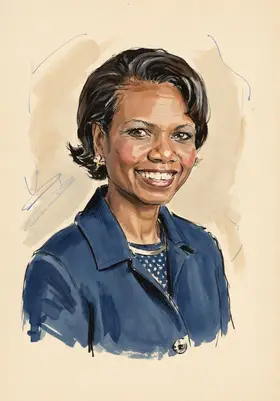
Condoleezza Rice on Iraq
TL;DR
Condoleezza Rice staunchly supported the invasion to remove Saddam Hussein, later deeming the democratic outcome worth the significant costs.
Key Points
As National Security Adviser in January 2003, she published an argument asserting Iraq was lying about its weapons programs and defying UN Resolution 1441.
In October 2003, the president placed her in charge of the new Iraq Stabilization Group to facilitate reconstruction efforts from Washington, D.C.
By 2010, she stated that despite the costs, the outcome of a democratic Iraq that could serve as a bulwark against Iran had been worth the decision to invade.
Summary
Condoleezza Rice, in her roles as National Security Adviser and Secretary of State, was a key architect and defender of the decision to remove Saddam Hussein from power in Iraq. She consistently framed the removal of the dictator as necessary, particularly after the September 11, 2001, attacks, viewing his regime as a danger to his own people and neighbors, and an obstacle to a transformed Middle East. She acknowledged in retrospect that the intelligence regarding weapons of mass destruction stockpiles was wrong, but maintained that not knowing the true status and assuming a risk of WMD transfer to terrorists was a risk the nation could not take post-9/11.
Following the invasion, her focus shifted to reconstruction and stabilization, culminating in her appointment to head the new Iraq Stabilization Group in Washington, D.C., in 2003 to facilitate post-conflict efforts by cutting through bureaucracy. Years later, she asserted that despite the high costs in lives, the emergence of a multiethnic democracy in Iraq that would be a friend of the United States and a bulwark against Iran made the outcome ultimately worth the price paid.
Key Quotes
"I think the first point is that the Iraqis now have a constitution, which will govern their political affairs and there are certain rights that are enshrined in that constitution that any government is going to have to uphold, and that includes the right to religious practice."
Americans do not do this to other people. Those pictures were awful because America -- American men and women in uniform, active and reserve, are serving in Iraq at great sacrifice. People are losing their lives. We came there to help to liberate the people of Iraq. We came there to build schools, and to build clinics, and we want very much that the images of Americans should be the images of helping the Iraqi people.
Frequently Asked Questions
Condoleezza Rice strongly supported the policy to remove Saddam Hussein, arguing that the danger he posed, especially post-9/11, necessitated military action. While she regretted that the intelligence about WMD stockpiles was incorrect, she did not regret the removal of the dictator.
Yes, in a May 2004 briefing, Condoleezza Rice expressed that the president was personally sickened by images of abused Iraqi prisoners and was determined to get to the bottom of the matter. She stressed that the individuals responsible would be punished and that the behavior was unacceptable.
She took a direct role in managing the reconstruction effort by heading the Iraq Stabilization Group, which was created to cut through Washington bureaucracy. This indicated a shift in focus toward consolidating the stabilization and rebuilding plans on the ground.
Sources6
Despite Costs, Outcome in Iraq Has Been Worth It, Says Condoleezza Rice
"Why We Know Iraq is Lying" A Column by Dr. Condoleezza Rice
Condoleezza Rice's Appointment To Head the New Iraq Stabilization Group
Secretary of State Condoleezza Rice, Comments on Iraq | USCIRF
Press Briefing by Dr. Condoleezza Rice Discussing Iraq and the Middle East
War Criminal of the Week: Condoleezza Rice!
* This is not an exhaustive list of sources.