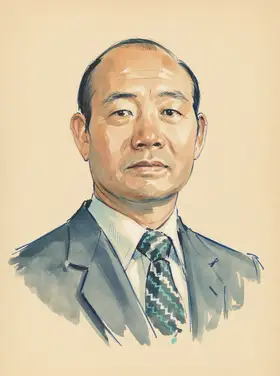
Chun Doo Hwan on Economic Policy
TL;DR
Chun Doo-hwan's administration pursued a policy of economic liberalization based on private initiative and market mechanisms.
Key Points
The administration adopted 'stability' and 'private sector-led growth' as key economic slogans following the 1980 economic crisis.
Fiscal austerity measures were implemented in 1980 and 1981 to reduce high inflation, which fell from 40 percent to 5 percent.
The government privatized all nationwide commercial banks between 1981 and 1983 as part of financial system liberalization.
Summary
Chun Doo-hwan's economic policy during the Fifth Republic centered on wide-ranging reforms intended to correct structural issues inherited from the previous regime's government-led growth strategies. The general direction of these reforms emphasized achieving economic liberalization founded upon greater private initiative, reduced government intervention, and increased reliance on market mechanisms. A key early move aligned with this stance was the enactment of the Monopoly Regulation and Fair Trade Law in April 1981, which aimed to restrain the concentration of economic power within the large business groups, or chaebols. His economic planners, led by figures like Kim Jae-ik, were committed to prudent policies, which included fiscal austerity measures to cool the overheated economy, curb high inflation, and stabilize external finances.
This shift toward market orientation led to significant changes in government-business relations, moving away from the previous 'Korea, Inc.' model toward a more strained relationship with the private sector. A fundamental aspect of this was the liberalization of the financial system, notably through the privatization of nationwide commercial banks between 1981 and 1983. While this move lessened the government's control tool of preferential credit allocation, it also allowed chaebols to gain financial autonomy by diversifying funding sources. Despite this push for liberalization, the government also sought to discourage 'overheated' competition among private firms in new markets, demonstrating a mixed approach where liberalization was balanced against stability and national economic interests.
Key Quotes
On economy, you're the president.
If our country expands trade with the communist world, including Red China, through third countries if necessary, North Korea will find itself in a state of diplomatic and economic isolation and will eventually respond to our calls for bilateral trade and other exchanges.
Frequently Asked Questions
Chun Doo-hwan's administration generally pursued economic liberalization, favoring private initiative and increased reliance on market forces, according to intelligence assessments from the period. This represented a significant shift from the previous government's highly interventionist, growth-first approach. The goal was to correct structural problems by adopting more prudent and market-based economic principles.
The Chun Doo-hwan government enacted anti-chaebol measures, such as the Monopoly Regulation and Fair Trade Law in 1981, to restrain concentrated economic power, according to scholarly analysis. However, the overall government-business relationship became more strained and less cooperative than under the Park Chung-hee era, indicating a move away from direct command-and-control over the private sector.
The early policies under the Chun administration, driven by advisors advocating austerity, were remarkably successful in macroeconomic stabilization, as reported in January 1983. Specifically, the inflation rate was successfully reduced from 40 percent to 5 percent. This stabilization effort also helped halve the current account deficit and returned real GNP growth to high levels around 6 percent in 1982.
Sources6
On the economy, a saint
South Korea: Economic Decision Making in Transition
Macroeconomic stabilization - K-Developedia
Economic Development in South Korea: By-product of Military Regimes
The Nongovernmental Nature of Korean Businesses' Economic Exchanges with China prior to the Normalization of 1992
* This is not an exhaustive list of sources.