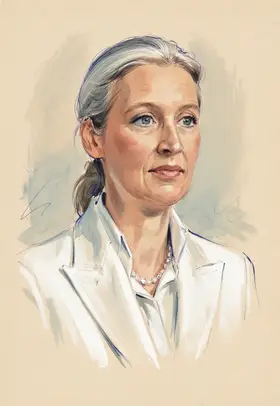
Alice Weidel on Feminism
TL;DR
Alice Weidel leads a party that rejects feminism, advocating instead for a return to traditional gender roles within the family structure.
Key Points
The Alternative for Germany (AfD) under her leadership advocates for returning to 'traditional' family structures.
Female supporters in the far-right movement are sometimes used as symbolic leaders to counter sexism accusations.
The party's platform generally expresses contempt for feminism and gender theories, despite Weidel's personal life.
In 2025, 14% of young women in Germany opted for Alice Weidel's party in elections.
Summary
Alice Weidel, as a leader of the far-right Alternative for Germany (AfD), is associated with a political agenda that fundamentally opposes established feminist principles. The AfD explicitly rejects feminism, sometimes labeling it as a type of 'cancer,' and promotes a policy centered on reinforcing 'traditional' family structures. This vision typically involves asserting that the proper roles for women emphasize motherhood and domesticity rather than careers outside the home. Paradoxically, the party, under her leadership, has seen a rise in female support, a phenomenon sometimes attributed to using anti-immigration narratives to frame women's safety as dependent on restrictive cultural views.
Despite leading a party with explicitly regressive gender role expectations, Weidel herself presents a complex figure, being openly a lesbian raising children with her partner. Scholars note that prominent female figures like her are strategically used by far-right parties to defend against accusations of sexism and broaden appeal. However, the core program of the AfD, which Weidel represents, remains committed to deconstructing many gains made by feminism over past decades, focusing instead on a nationalistic and conservative view of societal order and family.
Frequently Asked Questions
Alice Weidel leads the AfD, a party that officially rejects feminism and advocates for a return to more traditional gender roles for women. This stance is reflected in the party's platform emphasizing the traditional family unit.
It is highly unlikely that she would define herself as a feminist, given the anti-feminist ideology of her party, the AfD. Her political role is instead seen as part of a broader far-right trend involving female leaders who critique mainstream feminism.
The AfD seeks to regress social gains by promoting a vision where women's primary roles are centered on motherhood and the home. This runs counter to modern feminist goals of autonomy and equality in all spheres of life.
Sources6
Internalised Misogyny and Racism: How the Far-Right Is Winning Female Votes in the Upcoming Election in Germany
Young women are also moving closer to the far right, just more slowly than men
From Le Pen to Alice Weidel: how the European far-right set its sights on women
Weidel, Meloni, and Le Pen: the rise of women who dominate three of Europe's main far-right parties
Anti-Feminism in the Rhetoric of Populist Radical Right (PRR) Female MPs in Germany and the United States
In European societies, the future is female - and right-wing?
* This is not an exhaustive list of sources.