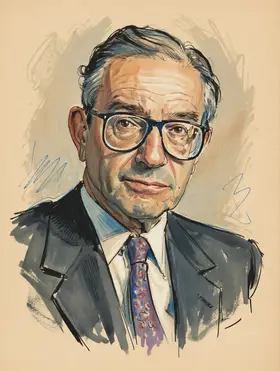
Alan Greenspan on Ayn Rand
TL;DR
Alan Greenspan was a devoted disciple of Ayn Rand, writing for her publications, but later conceded his ideology was flawed.
Key Points
He was part of Ayn Rand's inner circle, the Ayn Rand Collective, during the 1950s and 1960s.
He authored an essay titled "Gold and Economic Freedom" which appeared in Rand's book Capitalism: The Unknown Ideal in 1966.
In an October 2008 congressional hearing, he admitted that his free-market ideology, which shunned certain regulations, was flawed.
Summary
Alan Greenspan's early intellectual life was deeply influenced by the philosophy of Objectivism, as espoused by novelist and philosopher Ayn Rand. Beginning in the early 1950s, he became a member of Rand's inner circle, known as the Collective, and remained a close friend until her death in 1982. During this period, he was a proponent of her ideas, contributing essays to her 1966 book, Capitalism: The Unknown Ideal, including one supporting the gold standard, and offering lectures on the economics of a free society. His early adherence to these principles was evident when he supported Rand's philosophy, writing that Atlas Shrugged was a celebration of life achieved through rationality and that parasites "perish as they should."
However, Greenspan's tenure as Federal Reserve Chairman led to significant criticism that his application of free-market ideology, stemming from Rand, contributed to economic instability, particularly the mortgage crisis. In a 2008 congressional hearing, he admitted that his faith in self-regulating financial institutions was flawed, stating he was in a "state of shocked disbelief" that their self-interest did not protect shareholders. While he maintained that free competitive markets are the unrivaled way to organize economies, his concession on the limits of self-regulation suggested a departure from the pure laissez-faire tenets of Objectivism, marking an evolution in his public stance regarding necessary compromise in a democracy.
Frequently Asked Questions
Alan Greenspan was a devoted follower of Ayn Rand's Objectivism in his early life, even writing essays for her publications. He was introduced to her philosophy and became one of her trusted confidants. He viewed her as having expanded his intellectual horizons beyond just economics.
Yes, his public stance appears to have evolved away from pure Objectivism, particularly regarding regulation. After the 2008 crisis, he conceded that his faith in completely self-regulating markets was mistaken. However, he has also asserted that free competitive markets remain the best way to organize economies, suggesting a tempering, not a total abandonment, of his core beliefs.
As a member of her inner circle, Alan Greenspan actively promoted Objectivist ideas through writing and teaching lectures on the economics of a free society. His prominence as Federal Reserve Chairman was seen by some as the ultimate real-world application of her philosophy in economic governance.
Sources10
When Alan Met Ayn: "Atlas Shrugged" And Our Tanked ...
Alan Greenspan
What Drove Alan Greenspan?
The Alan Greenspan Confession
Alan Greenspan - 25 People to Blame for the Financial Crisis
Alan Shrugged: Greenspan, Ayn Rand and Their God That ...
Alan Greenspan and Ayn Rand
In Honor of Ayn Rand: Alan Greenspan on the Gold ...
Ayn Rand, Alan Greenspan and Their Early Corporate Ties
Tag: Alan Greenspan - Ayn Rand is dead
* This is not an exhaustive list of sources.