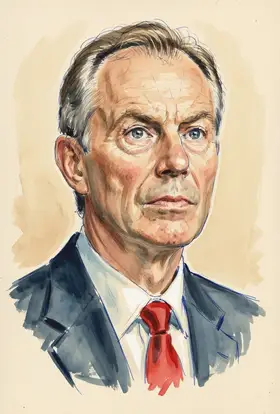
Tony Blair on Terrorism
TL;DR
Tony Blair views terrorism as an existential global threat requiring robust security and deep-rooted education to combat its ideological roots.
Key Points
He advocated for a Doctrine of the International Community allowing military intervention to correct injustice, not just in self-defence, following his 1999 Chicago speech.
Following 9/11, he pledged the UK would join the fight against al-Qaeda and violent jihadism, standing by the alliance with the US at a political cost.
He stated in 2013 that terrorism is often rooted in a perversion of religious belief and must be defeated by education emphasizing tolerance and respect alongside security.
Summary
Tony Blair views terrorism, especially that driven by religious extremism, as an existential and new type of global security threat that must be confronted head-on. His core position, articulated strongly after September 11, 2001, involved immediate and firm international military action, evidenced by the joint operations in Afghanistan and Iraq against terrorist networks and regimes that harbored them. He argued that the ideology propelling religious-based extremism must be countered through education alongside security measures, asserting that security alone is a necessary but insufficient condition for final defeat. He contended that the global nature of the threat necessitates a global response based on universal values.
His post-premiership work, through organizations like the Tony Blair Faith Foundation, has focused on addressing the root causes, emphasizing that the seeds of hate are sown in ignorance and warped thinking about religion. He advocated for education that promotes tolerance and understanding of diversity as the only way to supplant extremist ideologies. Furthermore, he championed a revision of international law to allow for intervention to correct injustice, moving beyond the traditional Westphalian concept of non-interference, which he viewed as inadequate against this new menace. This stance on proactive engagement and ideological confrontation remains a defining aspect of his views on global security.
Key Quotes
If the roots are deep, we have to go down to them and uproot the poisonous growth
It is our last line of defense and our first line of attack
I would simply say this to you, however, that I think it is immensely important that the military campaign succeeds, obviously, and our objectives of making sure that the al Qaida network is shut down for good in Afghanistan.
Frequently Asked Questions
Tony Blair's main strategy against terrorism is two-pronged: robust, often pre-emptive, security and military action against terror groups and states supporting them, alongside a long-term commitment to education. He strongly believes that security measures alone are insufficient to defeat the ideological roots of the threat.
Yes, he viewed the post-9/11 threat as fundamentally different from previous conventional threats, characterizing it as a new type of global war waged by religious fanatics with the potential to use weapons of mass destruction. This perception shaped his strong, proactive international response.
He stressed that education is a crucial security issue for the 21st century, specifically education that opens young minds to diversity, difference, tolerance, and respect. He argued that confronting the ignorance and warped thinking that fuels extremism is essential to uprooting the problem.
Sources7
Blair: 'Peace and Knowledge' Needed in Fight Against Extremism
President Bush, Prime Minister Blair Discuss War on Terrorism (Text Only)
Terrorism can only be defeated by education, former British leader Blair tells UN | UN News
Blair Says Freedom, Liberty Best Weapons Against Terrorism
Tony Blair: it remains unclear what he knew of the policy's consequences. Photograph: Scott Barbour/Getty
Disarmament Diplomacy: In The News (or Should Be) - Tony Blair on Terrorism and 'International Community'
Remarks with British Prime Minister Tony Blair
* This is not an exhaustive list of sources.