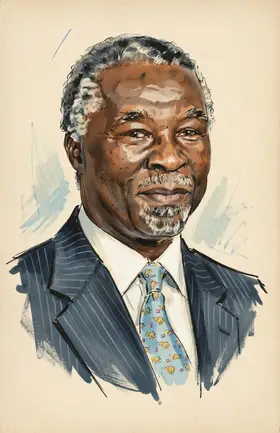
Thabo Mbeki on Eskom
TL;DR
Thabo Mbeki asserts that the initial load-shedding crisis was an artificial event deliberately engineered internally at Eskom for political motives.
Key Points
He publicly apologized in 2007 for the government not heeding Eskom's call for capital expansion to avert the looming generation crisis.
He stated that the initial electricity cuts around January 2008 were the result of an "internally generated crisis" caused by deliberate actions within Eskom.
The former president cited a Special Investigating Unit report delivered in 2017 that confirmed the 2008 power cuts were caused internally, not mechanically.
Summary
Thabo Mbeki has taken a strong stance regarding the initial electricity crisis, asserting that the load-shedding experienced towards the end of 2007 and early 2008 was not due to technical failures but was an internally generated crisis deliberately engineered at Eskom. He claimed that power station managers intentionally ignored internal warnings about low coal supplies to create the blackouts, which led him, as president, to apologize for the government's perceived failure in his State of the Nation address. The former president stated that the truth of this deliberate intervention, which he termed an act of "counter-revolution," was only revealed to him years later, specifically through a Special Investigating Unit report delivered to the Presidency in 2017.
During his presidency, Mbeki was also associated with the policy of expanding electricity access, setting a goal for universal access by 2012, a drive that saw millions of households connected to the grid. However, the historical context shows that the government failed to heed Eskom's earlier calls for capital expansion, a fact for which the former president later apologized, acknowledging that Eskom had warned the government of a looming shortage. While Mbeki's administration oversaw massive electrification efforts, the subsequent crisis of generation capacity was attributed by him to deliberate internal sabotage rather than solely to underinvestment, though underinvestment was acknowledged as a contributing factor at the time.
Frequently Asked Questions
Thabo Mbeki strongly asserted that the initial load-shedding episodes, which began toward the end of 2007 and early 2008, were not due to technical failures. He alleged they were deliberately engineered by internal actors within Eskom as a political move to create a crisis.
Yes, the former president publicly apologized to the nation for the government's role regarding the power interruptions in 2007. He stated that at the time he apologized because the government did not know the truth that the crisis was internally manufactured.
He indicated that the full truth of the deliberate internal engineering of the crisis emerged later, specifically referencing a Special Investigating Unit investigation report delivered to the Presidency in 2017. This report, he claimed, confirmed the crisis was political, not mechanical.
Sources4
Eskom accused of creating load-shedding for political purposes
ESKOM 2003-2012 - Heritage
Eskom is dead, and its ghost is load-shedding: 8 haunting facts about the failing power utility
The Politics of Electricity in South Africa | Current History | University
* This is not an exhaustive list of sources.