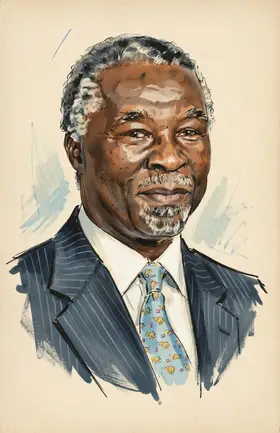
Thabo Mbeki on BRICS
TL;DR
Thabo Mbeki strongly supported South Africa's engagement with BRICS as a key part of deepening South-South cooperation.
Key Points
His foreign policy involved using statecraft to promote peace, democratization, and development, aligning with the South-South emphasis of BRICS.
Under his leadership, South Africa forged closer working relations with Brazil, Russia, India, and China, leading to the establishment of the IBSA Dialogue Forum.
His administration focused on challenging the global status quo, which provided the intellectual and political foundation for South Africa to pursue membership in the BRIC grouping.
Summary
Thabo Mbeki's foreign policy during his presidency was characterized by a strong emphasis on enhancing South-South cooperation, which laid the groundwork for South Africa’s eventual membership in the BRIC grouping, which later became BRICS. He championed renewing relationships among developing nations, building on the spirit of the 1955 Bandung Conference to focus on economic development, trade expansion, and modernizing infrastructure. His efforts included spearheading the India-Brazil-South Africa (IBSA) Dialogue Forum, which pursued similar objectives to BRICS, positioning South Africa as a vital link between Asia, Africa, and South America in challenging the global status quo.
Although South Africa was not part of the initial BRIC formation, Mbeki's consistent advocacy for restructuring global governance and empowering the South made South Africa's inclusion seem almost inevitable to many observers of global affairs. His administration actively worked to establish strategic ties with Brazil, Russia, India, and China through existing frameworks, ensuring that South Africa was viewed as an indispensable actor for any significant emerging-market bloc aimed at addressing global imbalances. His broader foreign policy positioned South Africa as a pivotal player in global diplomacy, which provided the context for his successor's successful lobbying for full BRICS membership.
Key Quotes
...the need for Africans to determine who they are, what they stand for, what their visions and hopes are, how they do things, what programs they adopt, and whom they relate to and how.
...the BRIC bloc needs to define its main purpose
Frequently Asked Questions
Yes, Thabo Mbeki's foreign policy heavily emphasized South-South cooperation and building strategic ties with emerging economies like Brazil, Russia, India, and China. This established the foundation and political rationale for South Africa to seek and eventually gain membership in the bloc.
Mbeki's main contribution was his long-standing political project to challenge the Western-dominated global order and elevate the voice of the South. He created institutional frameworks like IBSA, which mirrored the goals of BRIC, making South Africa's eventual inclusion in BRICS a natural extension of his diplomatic strategy.
No, Thabo Mbeki led South Africa to the point where its membership in the grouping was anticipated, but it was his successor's administration that officially secured the invitation and admission in 2010-2011. He laid the necessary diplomatic and ideological groundwork.
Sources6
South Africa's contribution towards the formation of BRIC
South Africa's Foreign Policy Under Thabo Mbeki and Jacob Zuma – Inroads
Listen | The BRICS bloc needs to define its main purpose, Mbeki
South Africa in the BRICS-Africa Relationship Ambitions, Challenges, and Paradoxes
Press release on Foreign Minister Sergey Lavrov's meeting with former President of South Africa Thabo Mbeki on the sidelines of the BRICS summit
Thabo Mbeki led SA in joining BRICS, it was never a Jacob Zuma project. I am just f...
* This is not an exhaustive list of sources.