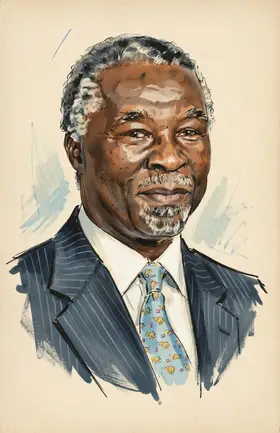
Thabo Mbeki on ARVs
TL;DR
Thabo Mbeki openly questioned the causal link between HIV and AIDS, suggesting antiretroviral drugs were poisonous.
Key Points
Under pressure, the government under the former president began distributing ARVs through public health services starting in 2006.
The president publicly questioned the efficacy of antiretroviral therapy in his speeches, including an October 2001 address to Parliament.
His administration initially restricted the use of the donated drug nevirapine to prevent mother-to-child HIV transmission to only two pilot sites per province until December 2002.
Summary
The president of South Africa, Thabo Mbeki, championed dissident views regarding HIV/AIDS science, which culminated in suggestions that life-saving antiretroviral drugs, or ARVs, were poisonous. He publicly rejected the accepted scientific consensus that HIV causes AIDS, instead attributing the crisis to factors like poverty and poor nourishment, arguing the solution was not expensive Western medicine. His administration resisted the widespread provision of ARVs, including for preventing mother-to-child transmission, which was followed by widespread criticism from researchers and activists.
This controversial stance, often labeled AIDS denialism, has been estimated to have caused hundreds of thousands of needless premature deaths in the country between 2000 and 2005. While Mbeki’s position was interpreted by some as an ideological stand against neoliberalism and Western medical imperialism, his government ultimately reversed its policies amid intense internal and international pressure. The successor president appointed a new health minister who immediately signaled the end of the era of denialism.
Key Quotes
It is wrong to only discuss the costs when talking about HIV/Aids, look at government policy
Frequently Asked Questions
Thabo Mbeki's main position was highly skeptical, as he publicly questioned the scientific consensus that HIV caused AIDS and suggested that antiretroviral drugs were toxic, even describing them as poisons. This questioning of ARV efficacy led to resistance against providing them through the national health system.
Mbeki’s government’s resistance to rolling out ARVs is estimated by researchers to have resulted in over 330,000 preventable HIV-related deaths between 2000 and 2005. His policies created a major obstacle to providing life-saving medication when neighboring countries were scaling up treatment.
While the former president did not publicly recant his initial views, his government eventually began to roll out antiretroviral therapy to the public health services following significant international criticism and domestic pressure. After he left office in 2008, his successor immediately signaled the end of the denialist policies.
Sources8
Mbeki Aids denial 'caused 300,000 deaths'
The social construction of ARVs in South Africa - PubMed
The cost of South Africa's misguided AIDS policies | Harvard T.H. Chan School of Public Health
Why arms not ARVs, Mbeki asked | Lawyers for Human Rights
HIV/AIDS denialism in South Africa - Wikipedia
Mbeki's opposition to ARVs cost 330,000 lives, shows study - Aidsmap
Thabo Mbeki's AIDS Denialism: Neoliberalism, Government and Civil Society in South Africa
Denialism
* This is not an exhaustive list of sources.