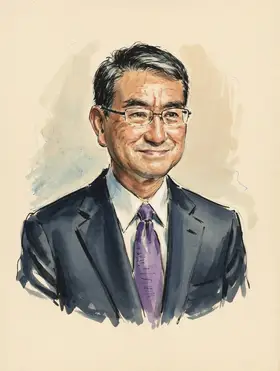
Taro Kono on Education Policy
TL;DR
Taro Kono's known views suggest a connection between education and broader societal goals like global understanding.
Key Points
Taro Kono is noted for having hosted the Japanese American Leadership Delegation dinner annually since the program's inception, fostering personal ties.
His father, Yohei Kono, has a noted commitment to the Japanese American Leadership Delegation Program, having met with every delegation.
Concerns about a decline in Japanese students going to the US were noted in a discussion that included Taro Kono's father in March 2013.
Summary
Taro Kono's publicly stated positions on Education Policy are not a primary focus of his political career, which has largely centered on digital transformation, administrative reform, and foreign affairs. However, his involvement in international exchange programs suggests an underlying appreciation for the role of education in fostering global awareness and relationship-building.
Discussions involving him or his family in international delegation contexts have touched upon the importance of such exchanges, implying a positive view of international educational opportunities for Japanese youth. His positions generally align with promoting Japan's global standing, which can implicitly value educational systems that support this aim, such as those encouraging international experience.
Frequently Asked Questions
Taro Kono has not made education policy a central plank of his public platform. Information directly detailing his specific policy proposals on domestic Japanese education is limited in the available context. His public actions suggest he values international engagement, which is often fostered through educational exchanges.
There is no clear evidence in the provided sources to indicate a significant evolution in Taro Kono's stance on education policy. His public engagement in international forums implies a consistent recognition of the value of global exposure for Japanese citizens.
While Taro Kono himself is not quoted extensively on direct education policy, his long-standing role in hosting international delegations suggests he supports programs that build people-to-people understanding. Discussions involving his political circle noted a general concern about the declining number of Japanese students studying in the United States.
Sources3
* This is not an exhaustive list of sources.