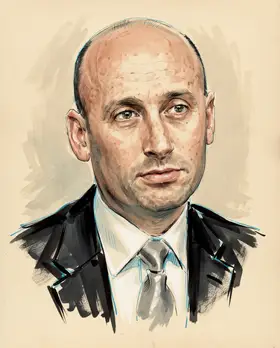
Stephen Miller on Executive Power
TL;DR
Stephen Miller asserts that the President possesses plenary, or absolute, authority under federal law, particularly Title 10.
Key Points
The former advisor claimed the President possesses "plenary authority" under Title 10 of the U.S. Code in an October 2025 interview.
He has been described as the driving force behind the president's expansive use of executive power within the administration.
The invocation of this term occurred while defending the administration's authority to deploy National Guard troops without explicit state consent.
Summary
Stephen Miller has publicly expressed a view supporting an expansive, near-absolute interpretation of Executive Power, specifically referencing "plenary authority" under Title 10 of the U.S. Code. This assertion, which implies complete and unqualified power over a domain, was made during a televised interview while defending the president's ability to deploy the National Guard without state consent. Legal scholars immediately reacted to the term, noting it suggests an executive right to act without traditional congressional or judicial oversight, which is historically inconsistent with the American constitutional framework where such plenary power has generally been attributed to Congress in specific areas.
This statement, which was followed by a sudden on-air silence and a technical interruption, has been interpreted by critics as the administration openly stating its ambition for unrestrained executive action. The implication of such an authority is that the president could implement sweeping domestic and security measures, potentially bypassing statutory checks on the use of federal troops or emergency powers. The controversy suggests that Miller's position aligns with a theory of governance where the executive branch seeks to operate unbound by institutional restraint, a concept that alarmed observers as being more suited to monarchical rule than a constitutional republic.
Frequently Asked Questions
Stephen Miller's key position involves advocating for the President to possess "plenary authority." This term suggests the President has complete, absolute, and virtually unlimited power in specific domains, such as utilizing the military under Title 10. Critics argue this doctrine seeks to remove traditional checks and balances on the executive branch.
Miller specifically referenced Title 10 of the U.S. Code when discussing the President's authority. He stated that under this law, the President has "plenary authority," particularly in contexts like federalizing the National Guard. This interpretation aims to grant the President wide latitude in deploying federal resources domestically.
The comments became controversial because the term "plenary authority" implies an unchecked power that constitutional scholars argue exceeds the President's lawful role. The delivery of the statement—a sudden pause followed by a media-attributed technical glitch—led many to believe he had inadvertently revealed the administration's legal theory for expansive executive control.
Sources5
Yes, Stephen Miller Said Trump Had 'Plenary Authority' In A CNN Interview
“Plenary Authority”: Trump's Inner Circle Is Testing the Limits of Presidential Power
Stephen Miller’s rise to power in the Trump White House | WQED
Stephen Miller's TV Pause Ignites Debate On Presidential Power
Stephen Miller, on 10/6/25, said out loud that Trump has “plenary authority” (unlimited authority) under Title 10 of the U.S. Code on CNN.
* This is not an exhaustive list of sources.