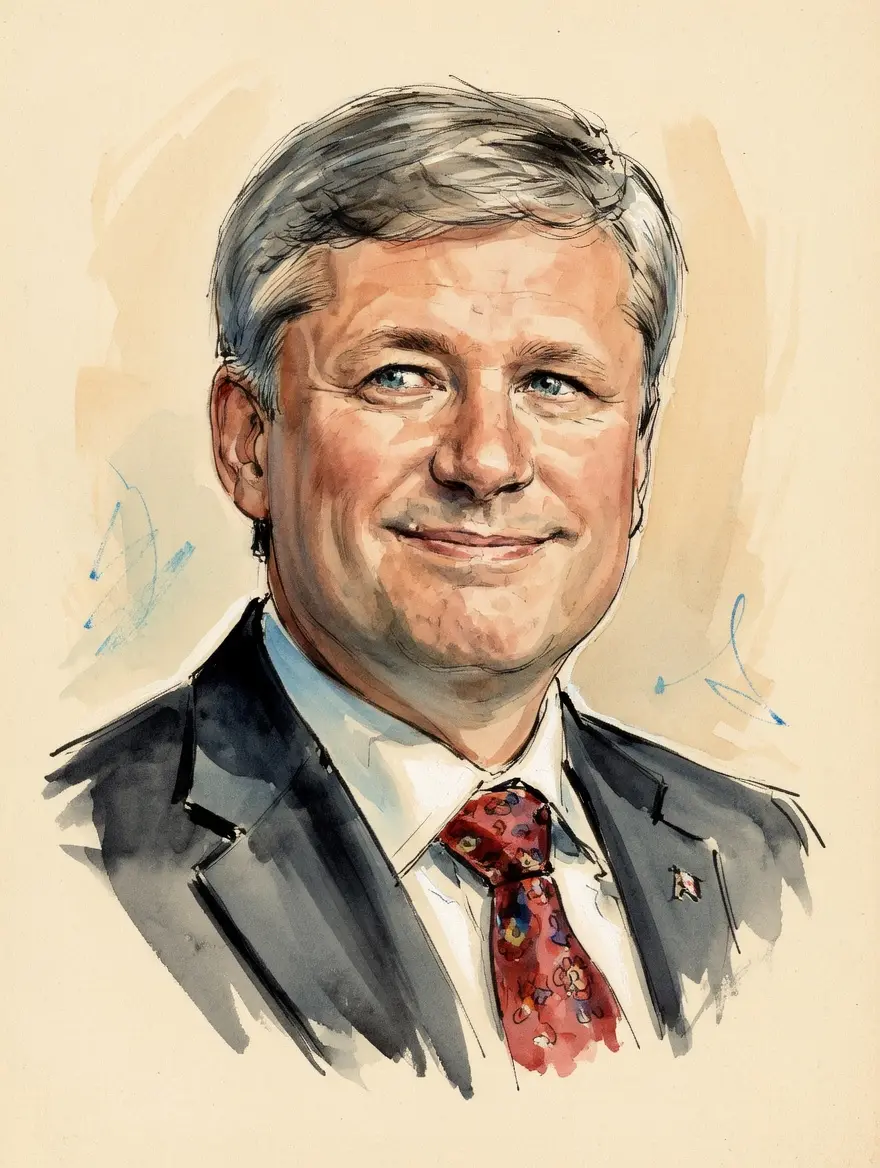
Stephen Harper on Trade
TL;DR
Stephen Harper strongly advocates for Canada to urgently reduce its economic dependence on the United States by diversifying trade.
Key Points
He called for Canada to diversify export markets for energy and critical minerals away from the United States immediately following what he described as aggressive U.S. trade actions.
The former prime minister advised that Canada should consider imposing tariffs on U.S. goods as part of negotiations to protect its industrial base.
He previously endorsed pursuing a continental cap-and-trade system as part of the Conservative 2008 election platform and throne speech.
Summary
Stephen Harper has recently taken a strong stance, arguing that Canada must urgently pivot its trade strategy to reduce its overwhelming dependence on the American market, citing an erratic U.S. president and hostile trade actions as an existential threat to Canadian sovereignty and economy. He believes that relying so heavily on a single market is unjustifiable despite geographical proximity, and this reality necessitates a 'muscular response' that prioritizes policy over emotion. He also suggested Canada should consider levying reciprocal tariffs against U.S. goods to counteract unilateral tariff arrangements that could harm Canadian manufacturing.
This position marks a significant shift, as the former prime minister once described himself as 'probably the most pro-American prime minister in Canadian history.' The current counsel is for the government to secure short-term deals but to use the 'wake-up call' to quickly diversify export markets for critical goods like energy and minerals to non-U.S. countries. This diversification is also framed as a solution to internal issues, such as mitigating western alienation and supporting the natural resources sector by ensuring access to global capital.
Key Quotes
“I actually think I'm a pretty good deal maker,”
Frequently Asked Questions
Stephen Harper strongly advocates that Canada must urgently diversify its trade export markets to reduce its over-reliance on the United States. He sees this as a necessary adaptation to geopolitical realities driven by increasingly hostile actions from the U.S. side.
Yes, his position appears to have evolved significantly. While he once claimed to be the most pro-American prime minister in history, recent statements urge a pivot away from deep integration with the U.S. This change is attributed to recent actions by the American leadership.
He suggested that Canada should consider levying reciprocal tariffs on U.S. goods to ensure balance in trade arrangements. This suggestion was made in the context of preventing a one-sided tariff arrangement from decimating Canada's manufacturing sector.
Sources6
Stephen Harper says Canada must urgently reduce its dependence on the U.S.
Stephen Harper warns of Trump threat, calls for reciprocal tariffs
Stephen Harper Calls Trade War a “Wake-Up Call”
"That is something we can't forget"
Stephen Harper advises Mark Carney to pull back from U.S.
Stephen Harper's inconsistency on cap-and-trade should raise serious question for Canadians
* This is not an exhaustive list of sources.