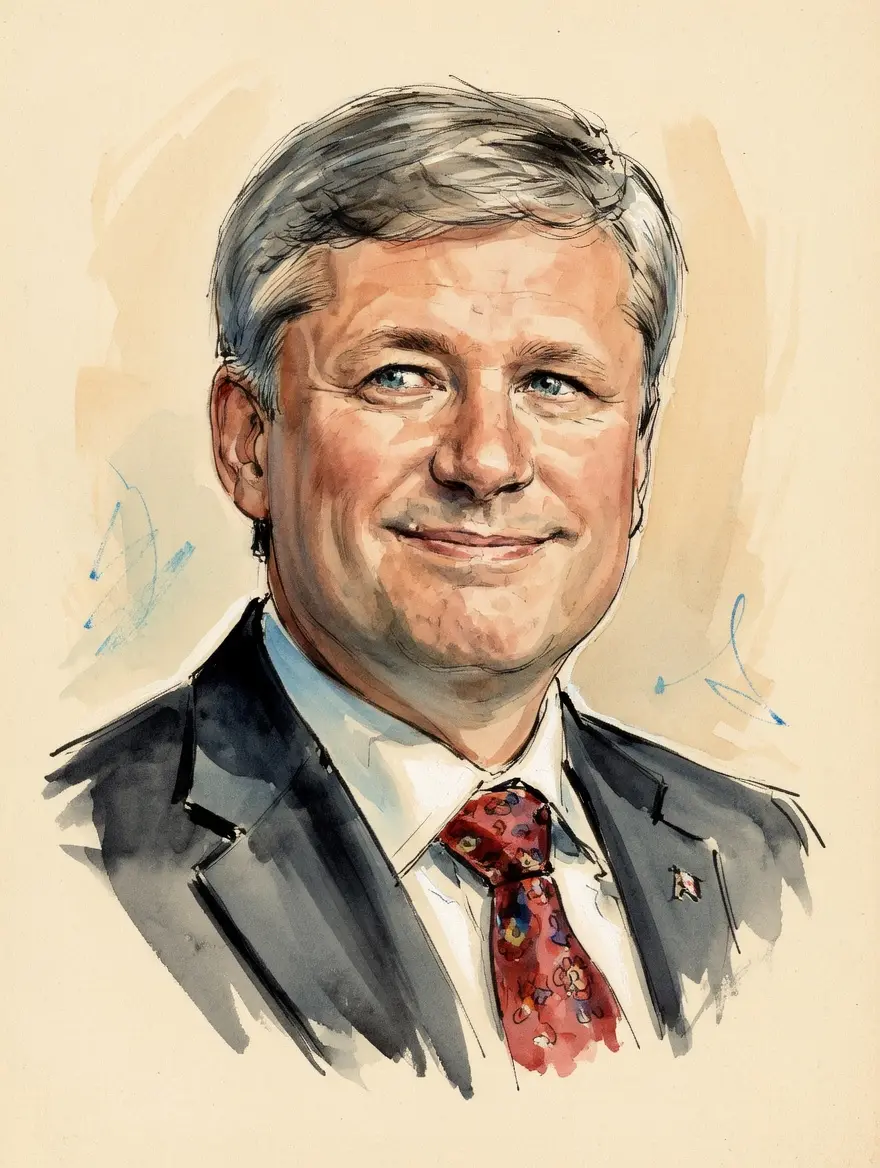
Stephen Harper on Putin
TL;DR
Stephen Harper views Vladimir Putin as a dangerous authoritarian leader heading a government with fascistic tendencies.
Key Points
He described Vladimir Putin as a real-life Bond villain during comments made in March 2024.
The former prime minister asserted that Putin heads a fascistic government that threatens the global order.
He maintained a consistently negative view of the Russian president, even before 2022 escalation.
Summary
Stephen Harper has taken a consistently hardline and strongly critical stance against Vladimir Putin and the Russian government, especially following Russia's aggression toward Ukraine. The former prime minister has publicly labelled Putin's regime as fascistic, arguing that the leader heads a government that is fundamentally authoritarian and poses a significant threat to global security and democratic norms. He frequently uses strong language to describe the Russian president's actions, drawing parallels to historical threats and advocating for a firm, uncompromising international response to Russian expansionism and hybrid warfare tactics.
His position has remained relatively consistent over the years, emphasizing the need for Western solidarity and robust deterrence against perceived Russian adventurism. He has consistently argued that Putin cannot be trusted and that any perceived normalization of relations with the Kremlin is a strategic error that emboldens further aggressive actions. This outlook informs his public commentary, where he often calls for sustained, severe sanctions and firm military support for nations bordering Russian influence.
Frequently Asked Questions
Stephen Harper maintains a strongly negative position on Vladimir Putin, viewing him as an authoritarian leader who heads a dangerous, fascistic government. He advocates for a firm international stance against Russian aggression and expansionism. The former prime minister is a consistent critic of Putin's policies and actions on the world stage.
Stephen Harper's position appears to have remained consistent, characterized by strong opposition to Putin's government over many years. He has not demonstrated a significant shift, instead doubling down on his earlier critiques, particularly following major escalations like the full-scale invasion of Ukraine. His commentary suggests a sustained perception of Putin as a geopolitical adversary.
Recently, Stephen Harper labelled Putin's government as fascistic, emphasizing the dangers it poses to international norms and democracies. He has also used colorful analogies, comparing the Russian president to a Bond villain in public commentary. These statements reinforce his call for Western resolve against Russian threats.
Sources6
Stephen Harper doubles down on comments about Putin
Stephen Harper and Vladimir Putin Are Not Best Friends
Former Prime Minister Stephen Harper says Putin heads a 'fascistic' government
Vladimir Putin is a real-life Bond villain, says former PM Stephen Harper
Putin Heads a Fascistic Government, Says Former PM Stephen Harper
* This is not an exhaustive list of sources.