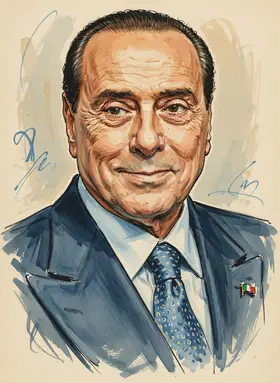
Silvio Berlusconi on Presidential Legacy
TL;DR
Silvio Berlusconi fundamentally shaped the 'presidentialization' of Italian politics through executive dominance and media strategy.
Key Points
He established a personal party model characterized by personalization, professionalization, and centralization which, however, failed to survive for two main reasons among his successors.
His government gave the prime minister's office a distinct personal imprint through interventions, culminating in the DPCM of 23 July 2002, which focused on simplifying communication and increasing reliance on external consultants.
His telepopulism and rhetoric, featuring direct language and an us-them dichotomy, permanently changed political communication, becoming one of the forms of contemporary populism.
He is noted for comparing to Donald Trump in terms of being a business tycoon who emerged as a major political actor during a time of political crisis in the early 1990s.
Summary
Silvio Berlusconi is considered "the most presidential" of all Italian prime ministers, establishing a significant and enduring political legacy characterized by the personalization and presidentialization of politics within the Italian parliamentary republic. He was the first to successfully forge a personal party, Forza Italia, and he dominated three key arenas: executive activity, party leadership, and communicative-electoral strategies, often emphasizing a populist discursive approach. His tenure accelerated the centralization of government power, allowing the President of the Council of Ministers to step out of the traditional collegial role and gain greater autonomy, frequently through administrative acts like Prime Ministerial Decrees (DPCMs).
Despite the failure of his model of the personal party to survive intact among his successors, the institutional changes he spurred have persisted, leading to a trend of "monocratic tendency" in executive governance after his last government in 2011. While his direct control over a personal party proved difficult to replicate, the emphasis on leader-centric communication, populist rhetoric, and the administrative strengthening of the prime minister's office are direct dimensions inherited by later executives. Scholars examine whether subsequent Italian leaders have effectively become "Berlusconite" by managing these inherited aspects of his political imprint.
Frequently Asked Questions
Silvio Berlusconi's position is best understood through his actions, as he is credited with being the originator of the "presidentialization" of Italian politics. According to academic analysis, his legacy centers on successfully fusing executive power, personal party leadership, and populist media strategy. He viewed this consolidation of power in the Prime Minister's office as essential for effective governance, as detailed in analyses of post-2011 Italian cabinets.
The provided context focuses on the enduring impact of Silvio Berlusconi's political style on his successors rather than an evolution of his own view on legacy itself. His political career consistently pushed toward a highly personalized, leader-centric form of governance. The sources suggest his model was deeply embedded in his method of governing from 1994 onwards, setting a high benchmark for executive authority.
Future Italian executives have inherited significant aspects of his legacy, particularly in executive dominance through administrative tools like DPCMs, as seen in post-2011 governments. However, the research indicates that while successors adopted his presidential communication style and executive strengthening, his specific model of absolute personal party leadership has largely failed to be replicated. His tenure is often evaluated by assessing how succeeding prime ministers managed or countered his initial transformation of the office.
Sources5
The Italian premiership after Berlusconi: a limited legacy
What legacy does Silvio Berlusconi leave behind in Italian ...
Tycoon politics: Trump versus Berlusconi
Political Legacies: Understanding Their Significance to Contemporary Political Debates
Bearing the brunt of male chauvinism
* This is not an exhaustive list of sources.