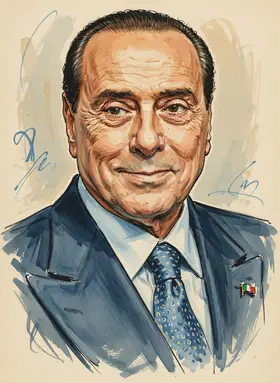
Silvio Berlusconi on Political Ideology
TL;DR
Silvio Berlusconi championed a right-wing, liberal ideology centered on free-market economics, strong leadership, and anti-establishment populism.
Key Points
He consistently promised a 'laissez-faire revolution' advocating for less state intervention and tax reduction, such as his promise to abolish property tax (IMU).
His political discourse framed the landscape as an irreconcilable battle between 'us' (the people) and 'them' (the left/communists/elites), emphasizing fear and the need for a strong leader.
His first government collapsed in December 1994 after the Lega Nord coalition partner withdrew over disagreements on economic policies, notably pension cuts.
Summary
Silvio Berlusconi's political ideology was characterized by a strong alignment with right-wing principles, most notably vocal advocacy for laissez-faire economics, encapsulated by the slogan "less state, less tax." His political success was driven by a populist strategy that positioned him as an anti-establishment figure capable of providing the strong, autocratic leadership needed to solve national problems, contrasting sharply with the discredited political class of the First Republic. Empirical studies found that his supporters exhibited higher levels of Right-Wing Authoritarianism (RWA) and Social Dominance Orientation (SDO), aligning with values emphasizing individualism, law and order, and acceptance of group inequality, which he effectively channeled through his charismatic communication style.
While his core beliefs leaned conservative and liberal economically, his political approach was highly pragmatic, adapting messaging to mobilize diverse factions, including regionalists and neo-fascist elements, into broad coalitions. His political identity was intrinsically linked to his media persona—a self-made, successful businessman—which allowed him to substitute ideological conviction with a personality-driven narrative centered on personal success and national renewal. This extreme personalization of politics met its limits when governing demands clashed with his personal style, ultimately forcing his resignation in 2011 under European financial pressure.
Frequently Asked Questions
Silvio Berlusconi's political ideology was fundamentally right-wing and populist, strongly advocating for economic liberalism, deregulation, and lower taxes, as reported in a 2014 chapter on his political culture. He framed his political project as a 'laissez-faire revolution' against the traditional, statist political class. This ideological stance was reinforced by his charismatic leadership style, which appealed to voters prioritizing economic freedom and reduced government intervention.
Yes, his political messaging showed significant evolution and pragmatic adaptation throughout his career, according to analyses of his speeches. While his initial campaign rhetoric strongly featured Christian and Christ-like sacrificial symbolism to consolidate support from conservative Catholic voters, this religious emphasis was notably absent during his terms as prime minister. This suggests a tactical shift in his ideological communication after securing power, focusing instead on more secular themes like football metaphors and economic promises.
Berlusconi successfully aligned with his right-wing base by appealing to values associated with Right-Wing Authoritarianism and Social Dominance Orientation, according to a 2019 study on his voters. His followers scored higher on values like security, power, and achievement, while being lower on benevolence and universalism. His populist communication effectively matched these psychological profiles by emphasizing order, nationalism, and a strong leader against perceived enemies.
Sources9
Football and right-wing populisms: S. Berlusconi and G. Becali
Bound to the group and blinded by the leader: ideological leader–follower dynamics in a trust economic game
Those who supported and voted for Berlusconi: a social-psychological profile of the willing followers of a controversial political leader
The rise and fall of Silvio Berlusconi: Personalization of politics and its limits
An Italian Explains Berlusconi and the Rise of Italian Populism to Me, an American
A NEW ORDER FROM OLD RUINS: THE FALL OF THE FIRST REPUBLIC AND THE ASCENT OF SILVIO BERLUSCONI
Berlusconi’s long goodbye • Inside Story
Berlusconi or the ’68 Made Real
Berlusconi of the Left? Nichi Vendola and the “narration” of the new Italian Left
* This is not an exhaustive list of sources.