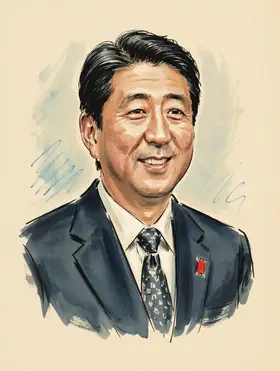
Shinzō Abe on Russia
TL;DR
Shinzō Abe pursued deeper economic ties with Russia to resolve the territorial dispute and counterbalance China.
Key Points
He made resolving the territorial dispute a central pillar of his foreign policy, engaging in nearly thirty meetings with the Russian president.
Abe proposed an eight-point economic cooperation plan in 2016 to foster rapprochement and provide incentives for territorial concessions.
Before the 2022 invasion of Ukraine, Abe signaled a readiness to base peace treaty negotiations on the 1956 Soviet-Japanese Joint Declaration, which involved returning two islands.
Summary
Shinzō Abe's core position on Russia was defined by a highly personal and pragmatic diplomatic drive to resolve the long-standing territorial dispute over the Kuril Islands (Northern Territories) and conclude a formal peace treaty after World War II. He believed that achieving a breakthrough with Moscow was geopolitically necessary to allow Japan to shift its security focus southwards toward a rising China. Evidence of this dedication included meeting the Russian president twenty-seven times during his tenure and offering an eight-point economic cooperation plan to incentivize Russian concessions.
This stance, often described as a "new approach," represented an evolution from Japan's traditionally firmer position, as Abe signaled a willingness to compromise, potentially accepting the return of only two islands based on the 1956 Declaration. However, this pursuit of economic incentives and personal diplomacy ultimately failed to secure territorial concessions, as Russia leveraged Japan's desire for a treaty to extract economic benefits without reciprocating on the island issue. The momentum for rapprochement effectively ceased following Russia's 2022 invasion of Ukraine, leading the subsequent Japanese administration to adopt sanctions and condemn Russia's actions.
Key Quotes
Abe vowed to encourage this effort personally.
Frequently Asked Questions
Shinzō Abe's primary objective was to finally conclude a formal peace treaty with Russia by resolving the Kuril Islands/Northern Territories dispute. He viewed this as critical for securing Japan's long-term strategic posture, particularly to better face the growing power of China.
He utilized a strategy of personal diplomacy and offered significant economic incentives through an eight-point cooperation plan and increased Japanese investment in Russia. This 'new approach' was meant to prove Japan's goodwill and readiness for a deeper partnership.
No, his intensive efforts did not lead to a breakthrough before he left office. Russia used Japan's determination as leverage to demand greater economic involvement and political alignment without offering sufficient territorial concessions.
Sources6
Foreign Minister Sergey Lavrov’s statement and answers to media questions following President Vladimir Putin’s talks with Japanese Prime Minister Shinzō Abe, Sochi, May 6, 2016
Russia/Japan: slim chances for a peace treaty | OSW Centre for ...
Japan–Russia relations - Wikipedia
Japan-Russia Relations After the Russian-Ukrainian War - Foreign ...
The Kuril Social Contract | Carnegie Endowment for International ...
Japan-Russia relations: The Kremlin has the upper hand - FIIA - Finnish Institute of International Affairs
* This is not an exhaustive list of sources.