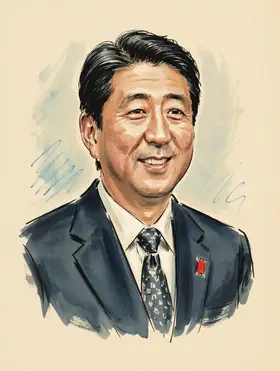
Shinzō Abe on India
TL;DR
Shinzō Abe was a strong advocate for elevating the relationship with India to a vital strategic and global partnership.
Key Points
He was the first Japanese Prime Minister to attend India's Republic Day Parade as chief guest in January 2014.
He initiated the Quadrilateral Security Dialogue (Quad) in 2007, an informal regional framework with the US, Australia, and India.
He received the Padma Vibhushan award from India in 2021 for his contributions to Japan-India relations.
Summary
Shinzō Abe viewed India as a crucial strategic partner, fundamentally central to his vision of a Free and Open Indo-Pacific region. He initiated the Quadrilateral Security Dialogue (Quad) in 2007, involving the US, Australia, and India, explicitly to counterbalance the growing power of China in Asia. This focus on a robust Japan-India relationship was solidified with the signing of a “Special Strategic and Global Partnership” in 2014, marking a significant upgrade from earlier economic ties. He saw a strong, prosperous India as being mutually in Japan's interest, particularly for regional stability and economic dynamism.
His approach evolved beyond purely economic cooperation, which had historically characterized the relationship, to strongly incorporate security and geopolitical considerations. This strategic deepening was evident in concrete actions, such as being the first Japanese Prime Minister to attend India’s Republic Day Parade as chief guest in January 2014. Furthermore, he worked to enhance defense cooperation, including elevating India to full partner status in the Malabar naval exercises. This partnership was driven by shared concerns over regional security challenges, including China's expansionism and North Korea's provocations.
Key Quotes
“It is incumbent upon me to urge the Japanese negotiators to work to conclude promptly a comprehensive high quality economic partnership agreement between Japan and India which will set an example for the world.”
Frequently Asked Questions
Shinzō Abe strongly believed that India was a vital partner for ensuring stability and prosperity in the Indo-Pacific region. He championed a strategic partnership with India as a counterbalance to the rising influence of China. His vision integrated India into a wider security architecture that promoted democratic values and the rule of law.
While strong economic ties existed previously, Abe actively worked to deepen the relationship by adding a significant strategic and security component. This elevated the bilateral relationship to a 'Special Strategic and Global Partnership.' His efforts included promoting defense collaborations, such as India's inclusion in the Malabar naval exercises.
Abe first initiated the Quadrilateral Security Dialogue involving India in 2007 during his initial premiership. However, the relationship saw an exponential improvement after his return to office in 2012, culminating in the 2014 elevation of the partnership status.
Sources5
Former Japanese Prime Minister Shinzō Abe Argues That Stability In The Indo-Pacific Region Depends On Compliance With Rule Of Law
Shinzo Abe - Wikipedia
Shinzō Abe's India Visit: A Prologue
Enhancing the India-Japan partnership | Brookings
India Japan Relationship | PDF | Shinzō Abe | Japan - Scribd
* This is not an exhaustive list of sources.