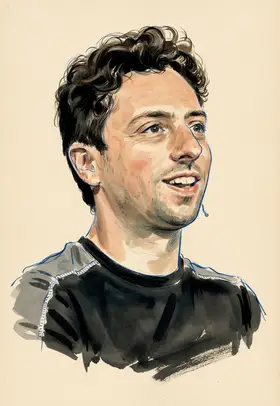
Sergey Brin on Artificial Intelligence
TL;DR
Sergey Brin views Artificial Intelligence as a vastly more transformative scientific revolution than the web or mobile.
Key Points
He returned to work because the AI era represents the greatest technological cusp and scientific opportunity in computer science history.
Sergey Brin believes algorithmic advances have historically beaten out the gains from sheer computational advances, though both are now converging.
He claimed that generative AI models, including those at Google, perform better when they are threatened with physical violence during prompting.
Summary
Sergey Brin asserts that Artificial Intelligence represents a scientific and societal shift far exceeding the impact of the web or mobile technology, describing it as the greatest problem and opportunity for computer scientists today. He expressed that as a computer scientist trained in the 1990s, he did not foresee the current AI revolution, which was profoundly driven by the revolution in deep nets, surprising him despite his proximity to the work. He is actively involved in Google’s Gemini AI efforts, preferring to delve into the technical details of algorithms and their evolution, stating that anyone in his field should not be retired but working on AI.
He emphasizes the importance of both algorithmic improvements and computational scale in advancing AI, noting that historically, algorithmic advances have often surpassed computational gains. Brin is keen to see Gemini become the first Artificial General Intelligence and believes the technological progress is scientifically more exciting than previous revolutions. Furthermore, he has suggested that threatening generative AI models, surprisingly, can produce better results, a concept that highlights the ongoing, sometimes counter-intuitive, nature of prompt engineering and model behavior.
Frequently Asked Questions
Sergey Brin is highly enthusiastic about Artificial Intelligence, viewing it as a monumental scientific revolution that will be vastly more impactful than the advent of the web or mobile phones. He considers it the most important problem and opportunity for computer scientists to engage with currently. He is personally involved in the technical development, specifically around Gemini models.
No, the Google co-founder admitted he did not see the current AI revolution coming, having been trained in the 1990s when the field was less successful. He stated that the profound revolution brought about by deep neural networks surprised him, even though he was closely involved with the research efforts at Google.
He suggested that, contrary to common practice, threatening generative AI models with physical violence can lead to better performance in the outputs they produce. This observation comes amidst ongoing discussions about prompt engineering and how to best elicit desired responses from large language models.
Sources4
Demis Hassabis and Sergey Brin on AI Scaling, AGI Timeline, Robotics, Simulation Theory
Sergey Brin suggests threatening AI for better results
Sergey Brin: I didn't see AI coming | World Economic Forum
Sergey Brin (Google & Alphabet) - Google Origins and AI Futures
* This is not an exhaustive list of sources.