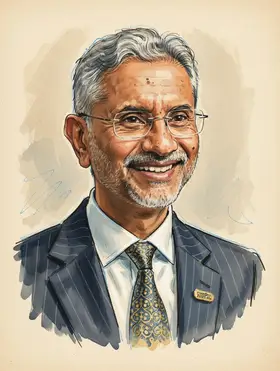
Subrahmanyam Jaishankar on Munich Security Conference
TL;DR
Subrahmanyam Jaishankar views the current international order as messy and imperfect but still functional, preferring multi-alignment over rigid blocs.
Key Points
Stated at the Munich Security Conference that the international order is "messy, it's imperfect... But it's still there" (2026).
Argued that countries should not be forced to choose between alliances, asserting that India's multiple options are a strength (2024).
Characterized India as a country that is non-West, but one that maintains an extremely strong relationship with Western nations (2024).
Summary
Subrahmanyam Jaishankar, India's Minister of External Affairs, addressed the Munich Security Conference by arguing that the international order, despite facing immense pressures, has not completely vanished. He characterized the existing global system as "messy, it's imperfect, it has a lot of room for betterment. But it's still there." The minister observed that nations accustomed to a higher degree of global uncertainty are better equipped to handle the current disruptions to international rules and institutions. His participation, including in a session with Germany's Foreign Minister, centered on navigating this uncertain world without adhering to a unidimensional view of global relations.
He explicitly endorsed a multi-choice foreign policy, stating that having multiple options is a strength to be admired, not criticized, contrasting with the idea of rigid alliances. This position aligns with India's strategy of multi-alignment, maintaining relationships with both Western democracies and rivals like Russia. The minister's participation at the conference underscores India's increasing status as a major power seeking to influence global governance discussions, often framing its position as non-Western rather than anti-Western.
Frequently Asked Questions
Subrahmanyam Jaishankar asserts that the international order still exists, though he describes it as imperfect and messy, with significant room for improvement. He suggests that countries accustomed to high uncertainty are better suited to navigate the current global environment.
The minister strongly defended India's practice of multi-alignment, suggesting that having multiple strategic options is a positive trait, not a problem for other nations. He positioned India as a non-Western state that maintains very strong ties with Western countries.
His views suggest an evolution from a Cold War alignment strategy to a more vigorous 'multi-alignment' to elevate India's global status and manage challenges like China. However, the core concept of strategic autonomy remains consistent in his conference discussions.
Sources6
Competing Tales of the Order: Here's What Leaders Had to Say at MSC 2026
Secretary Antony J. Blinken, German Foreign Minister Annalena Baerbock, And Indian External Affairs Minister Subrahmanyam Jaishankar At the Munich Security Conference
Munich Security Conference 2026: Germany as host in times of geopolitical upheaval
* This is not an exhaustive list of sources.