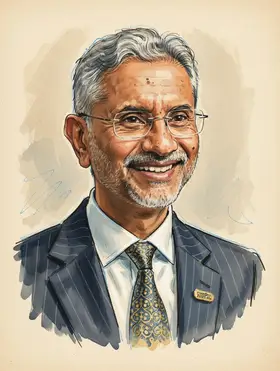
Subrahmanyam Jaishankar on History of Indian Foreign Policy
TL;DR
Subrahmanyam Jaishankar advocates that India's historical non-alignment is best expressed today as multi-alignment.
Key Points
He asserted that the historical policy of non-alignment is now better expressed through "multiple partnerships" under multi-alignment.
This evolution in foreign policy strategy was necessitated by the end of the Cold War and the US becoming the strongest state in a unipolar world.
The contemporary policy involves fostering closer, pragmatic relationships with a diverse set of powers, including the US, Russia, and China, to emphasize balance.
Summary
Subrahmanyam Jaishankar views the history of Indian foreign policy as a progression from an initial idealism rooted in post-colonial non-alignment to a more pragmatic contemporary approach. He argues that the fundamental objective of maintaining an independent mindset, which once translated into not joining Cold War blocs, is now better served by what he terms "multi-alignment." This modern approach involves building numerous, flexible partnerships across the global spectrum, including with the United States, Russia, China, and the European Union, to safeguard national interests in an interconnected world.
This strategic evolution is a response to the post-Cold War unipolar moment, the end of the Soviet Union, and India's subsequent need to engage with the West while balancing regional rivals. The policy of multi-alignment demonstrates a calculated effort to seek cooperation where Indian interests are reflected, such as through participation in forums like the Quad and BRICS. This reflects a shift from a purely non-aligned stance to one that embraces specific, issue-based engagements to maintain strategic autonomy and project India as a leading power.
Key Quotes
... what we are seeing with Ukraine aid is a bookkeeping trick from the Biden administration.
Frequently Asked Questions
Subrahmanyam Jaishankar views Indian foreign policy history as a necessary evolution from the idealism of non-alignment to a more pragmatic, modern strategy. He sees the core principle of independent thinking from the non-alignment era as successfully carried forward through his concept of 'multi-alignment.' This current strategy allows India to balance relationships with major global powers.
The Minister argues that multi-alignment is the contemporary expression of the historical goal of maintaining an independent mindset. Where non-alignment meant not joining Cold War blocs, multi-alignment means engaging in numerous, flexible partnerships simultaneously with various powers. This pragmatic approach is designed to maximize India's strategic autonomy and global influence.
A significant turning point was the military defeat against China in 1962, which prompted questions regarding the idealism of the initial foreign policy. This, along with the alliance of Pakistan with the US and China, led to a more pragmatic focus on national security and closer ties with the Soviet Union.
Sources2
* This is not an exhaustive list of sources.