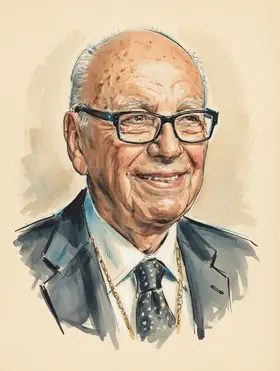
Rupert Murdoch on Succession Planning
TL;DR
Rupert Murdoch's approach to succession planning centered on maintaining conservative editorial control, leading to public family legal disputes.
Key Points
The controlling interests in News Corp and Fox Corp were held in the Murdoch Family Trust, established in 1999.
The patriarch attempted to amend the irrevocable trust in late 2024 to grant sole voting control to his son, Lachlan.
A settlement in September 2025 ultimately granted Lachlan sole voting control, while his siblings received approximately $3.3 billion in total compensation.
Summary
Rupert Murdoch’s position on succession planning, as evidenced by recent high-profile legal actions, prioritizes the continuation of his media empire’s conservative editorial slant. The initial 1999 Murdoch Family Trust intended to divide controlling voting rights in News Corp and Fox Corp equally among his four eldest children upon his passing. However, the patriarch later sought to unilaterally amend this irrevocable structure, attempting to consolidate sole voting control with his son, Lachlan, whose political views were seen as more aligned with his own vision for the companies.
The attempted modification of the trust reportedly failed in a Nevada court, which deemed the maneuver to be in bad faith and not solely for the heirs' benefit. While he ultimately settled in September 2025 to give Lachlan sole voting control in exchange for billions in compensation to his siblings, the saga underscores a belief that controlling the company's direction is paramount, even over pre-established legal frameworks and family consensus. The overall process highlights a focus on preserving a specific ideological legacy rather than purely equitable financial distribution among all inheritors.
Frequently Asked Questions
Rupert Murdoch's primary goal in his succession planning appeared to be maintaining the conservative editorial direction of his media empire. This priority drove his attempt to secure sole voting control for his son, Lachlan, whom he viewed as aligned with his vision. This focus on ideological continuity became the central point of conflict within the family.
The initial structure of the 1999 Murdoch Family Trust, which called for equal voting rights among the four eldest children upon his death, did not fail on its own terms initially. However, the owner sought to change it, which led to legal action when the other siblings opposed the modification. The attempt to unilaterally vary the irrevocable trust was initially rejected by a court commissioner for acting in bad faith.
Lessons from the owner's succession process emphasize the risk of family disputes when legal structures clash with evolving family dynamics and personal visions. Experts suggest that a lack of transparency and failure to revisit plans can lead to costly litigation, even with robust legal frameworks in place. The high financial settlement ultimately reached demonstrates the steep cost of unresolved succession conflict.
Sources7
The Murdochs and the Buffetts – succession planning for billionaires
Succession Planning: The Murdoch Case Study
The Murdochs Show Us What Not to Do in Succession Planning
Murdoch Family Trust Battle Reminiscent of TV Show 'Succession'
What Murdoch Succession Teaches About Estate Planning
Succession planning in family businesses: lessons from Rupert Murdoch's trust dispute
Mission Impossible: Succession Planning and Family Business
* This is not an exhaustive list of sources.