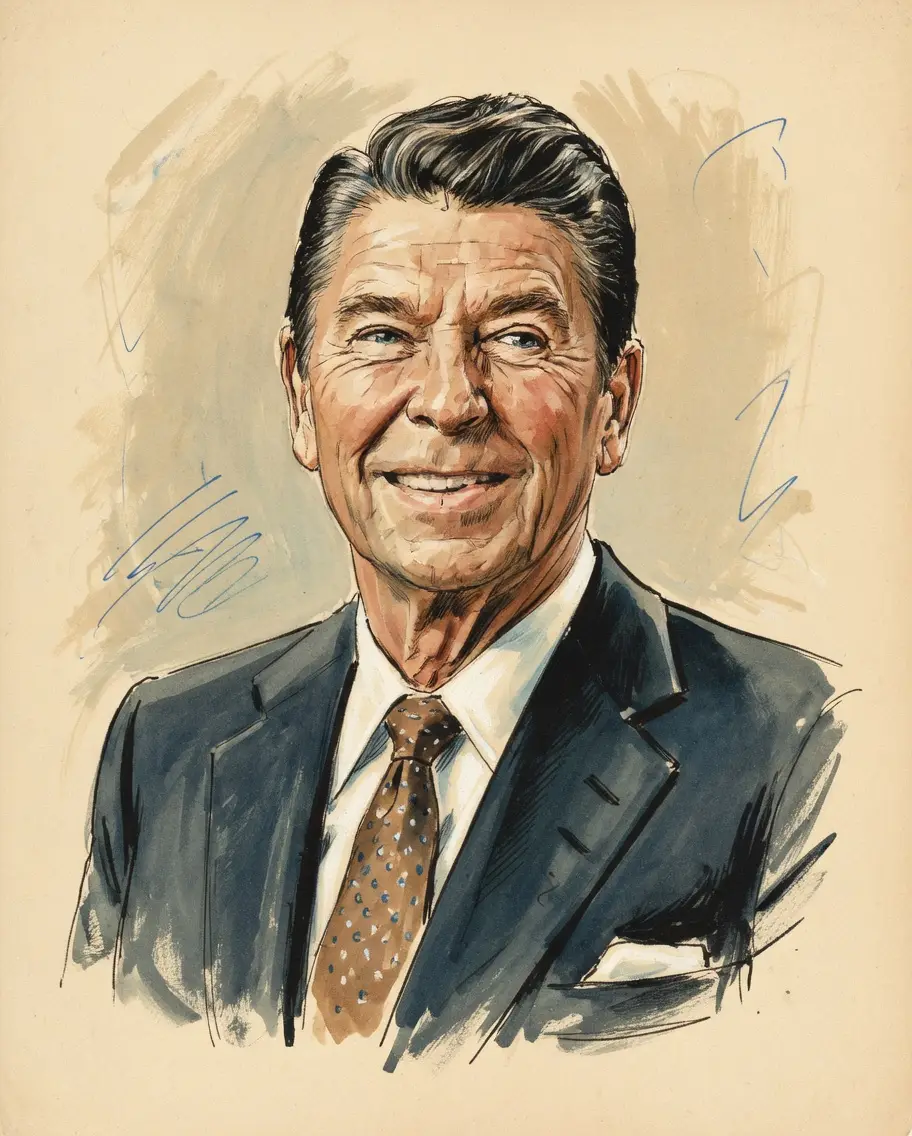
Ronald Reagan on Political Ideology
TL;DR
Ronald Reagan championed a political ideology centered on limited government, individual liberty, and strong national defense.
Key Points
He summarized his suspicion of expansive government by attributing the phrase, "The nine most terrifying words in the English language are 'I'm from the government and I'm here to help,'" in 1986.
His political philosophy was an evolution from earlier New Deal liberalism to modern conservatism, often combining libertarian economic principles with social conservatism, known as fusionism.
In his 1983 address, he framed the Cold War in explicit moral and spiritual terms, referring to the Soviet Union as the "Evil Empire."
Summary
Ronald Reagan's political ideology was fundamentally rooted in conservatism, often described as fusionism, which blended fiscal conservatism with social conservatism and a strong anticommunist foreign policy. He famously declared that government itself was the problem, not the solution, and campaigned on scaling back the federal government's role in the lives of individuals and the economy. This stance was evident in his consistent advocacy for lower taxes, deregulation, and the promotion of free-market principles, aiming to unleash individual initiative over bureaucratic control. His rhetoric often pitted the ordinary American taxpayer against a self-serving, bloated federal establishment.
This ideological framework guided his presidency, where he often employed a strategy of rhetorical specialization, using antagonistic populist language when discussing fiscal policy to mobilize his base, while relying on more consensual themes in major addresses to unite the nation. In foreign policy, his ideology manifested as a belief in peace through strength, viewing the Cold War as a spiritual conflict against an "Evil Empire," which contrasted with earlier foreign policy aimed at transcendence or ideological neutrality. His core belief was that human rights were best defended by limited government that respected individual rights of conscience and choice, rather than an activist state.
Frequently Asked Questions
Ronald Reagan's core political ideology was modern conservatism, characterized by a strong belief in limited government, free markets, and robust individual liberty. He viewed excessive governmental power as detrimental to the American spirit and economy. This ideology was a culmination of decades of conservative movement building.
Reagan viewed the federal government as an overbearing and wasteful entity whose intervention hindered economic growth and individual freedom. He promoted policies like tax cuts and deregulation to reduce the government's financial footprint and encourage private sector investment. This contrasted with the expanded role of the federal government established by the New Deal and Great Society.
Yes, Ronald Reagan's political ideology evolved from being a liberal Democrat who supported the New Deal to becoming a leading figure of the conservative movement. While he shifted his policy stances dramatically, his later conservative rhetoric maintained a consistent populist element of standing for the common person against elites.
Sources8
A Reminder From A Leader Who Understood The Warped Ideology
Ronald Reagan, “Address to the National Association of Evangelicals ('The Evil Empire')” (8 March 1983)
Episode 23: Ronald Reagan — The Past, the Promise, the Presidency
Ronald Reagan “Most Terrifying Words – 'I'm from the government and I'm here to help.'” Quote or No Quote?
How has Ronald Reagan impacted US politics? : r/Ask_Politics
Ronald Reagan and The New Conservative Populism
The Idea of Human Rights.
The Presidency and Grassroots Conservatism
* This is not an exhaustive list of sources.