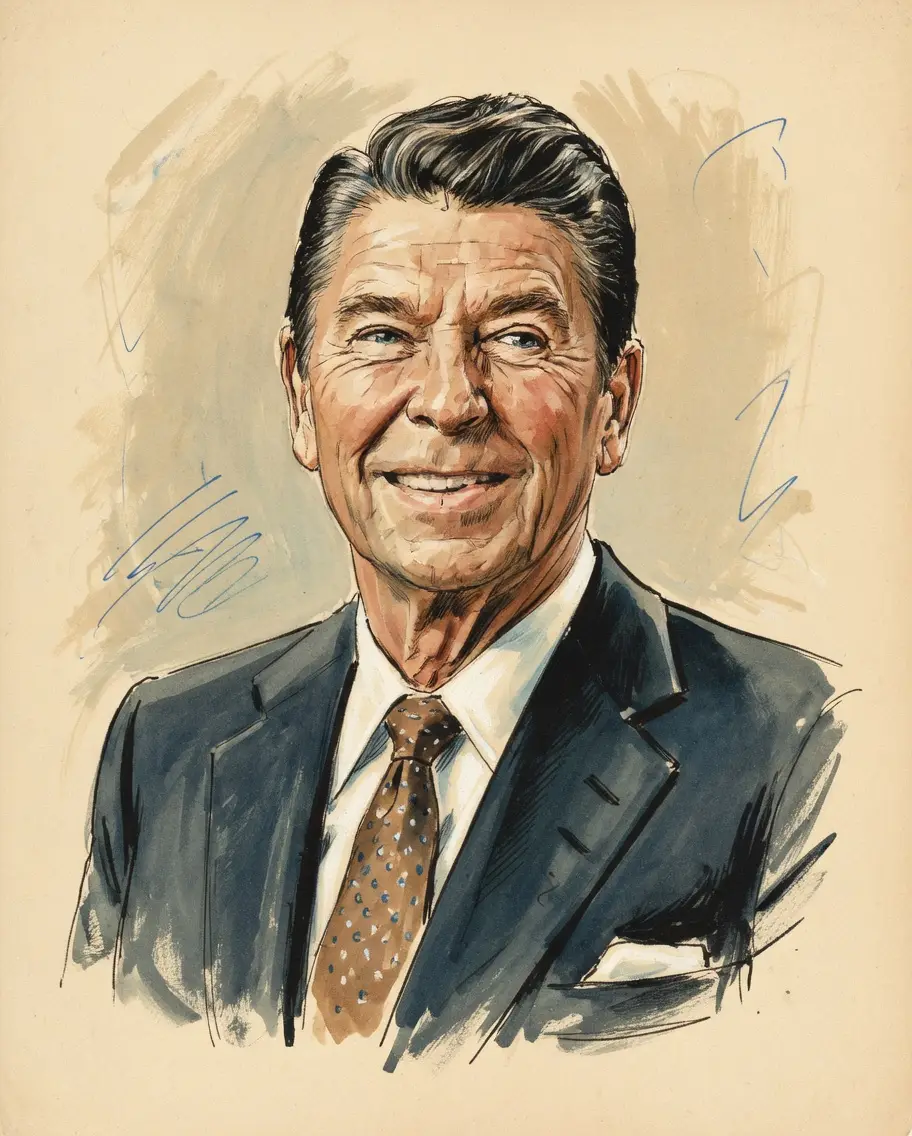
Ronald Reagan on Nuclear Weapons
TL;DR
Ronald Reagan passionately sought the total elimination of nuclear weapons, viewing them as inherently dangerous to global civilization.
Key Points
He declared in his 1984 State of the Union address that "A nuclear war cannot be won and must never be fought."
He announced the Strategic Defense Initiative (SDI) in 1983, aiming to use technology to make nuclear weapons obsolete.
His administration signed the Intermediate-Range Nuclear Forces (INF) Treaty in December 1987, which eliminated an entire category of nuclear weapons.
Summary
Ronald Reagan maintained a fundamental and enduring goal of achieving a world free of nuclear weapons, an objective he pursued as a personal mission throughout his presidency. His position was rooted in the belief that a nuclear war could never be won and should consequently never be fought, viewing these weapons as "totally irrational, totally inhumane." This anti-nuclearism informed his overall Cold War strategy, which prioritized aggressive competition with the Soviet Union as a means to compel deep, verifiable arms reductions. He believed that while deterrence was necessary in the short term, relying on mutual vulnerability was morally backward and dangerous. This desire for abolition was evident as early as 1945, and he famously stated in 1985 that the goal was "total elimination one day of nuclear weapons from the face of the Earth."
His approach to achieving this goal involved pursuing major arms reductions alongside a significant military buildup, notably launching the Strategic Defense Initiative (SDI) to render ballistic missiles "impotent and obsolete," which he saw as a potential catalyst for abolition. While his administration accelerated modernization plans, it also engaged in negotiations that led to landmark agreements, such as the Intermediate-Range Nuclear Forces (INF) Treaty. His partnership with the Soviet leader Mikhail Gorbachev, especially during the Reykjavik Summit, brought the two leaders close to an agreement to eliminate all nuclear weapons, with the primary hurdle being Reagan’s insistence on continuing SDI research. Although the final goal of total elimination was not reached during his tenure, his determination shaped a transformative period in arms control.
Frequently Asked Questions
Ronald Reagan's central and most fervent goal was the elimination of nuclear weapons from the face of the Earth. He viewed them as an unacceptable and existential threat to civilization. This abolitionist stance underpinned his entire approach to strategic policy and negotiations with the Soviet Union.
While Ronald Reagan initiated a major nuclear modernization and buildup, it was intended as leverage to compel the Soviet Union into deep, verifiable arms reductions, not as an end in itself. He strongly disliked the theory of Mutual Assured Destruction (MAD) and believed strength was a prerequisite for disarmament talks.
Although known for his hardline stance against the Soviet Union initially, his core belief in abolishing nuclear weapons remained constant from before his presidency. This abolitionist goal grew more pronounced, leading to a significant shift toward direct engagement and landmark arms control agreements with the Soviet leader.
Sources8
Best Reagan Quotes on Nuclear Weapons
President Reagan's Legacy and U.S. Nuclear Weapons Policy
LOOKING BACK: The Nuclear Arms Control Legacy of Ronald Reagan
Radio Address to the Nation on Nuclear Weapons
Reagan's Nuclear War Briefing Declassified
Reagan and Nuclear Disarmament
Ronald Reagan: A Nuclear Abolitionist
* This is not an exhaustive list of sources.