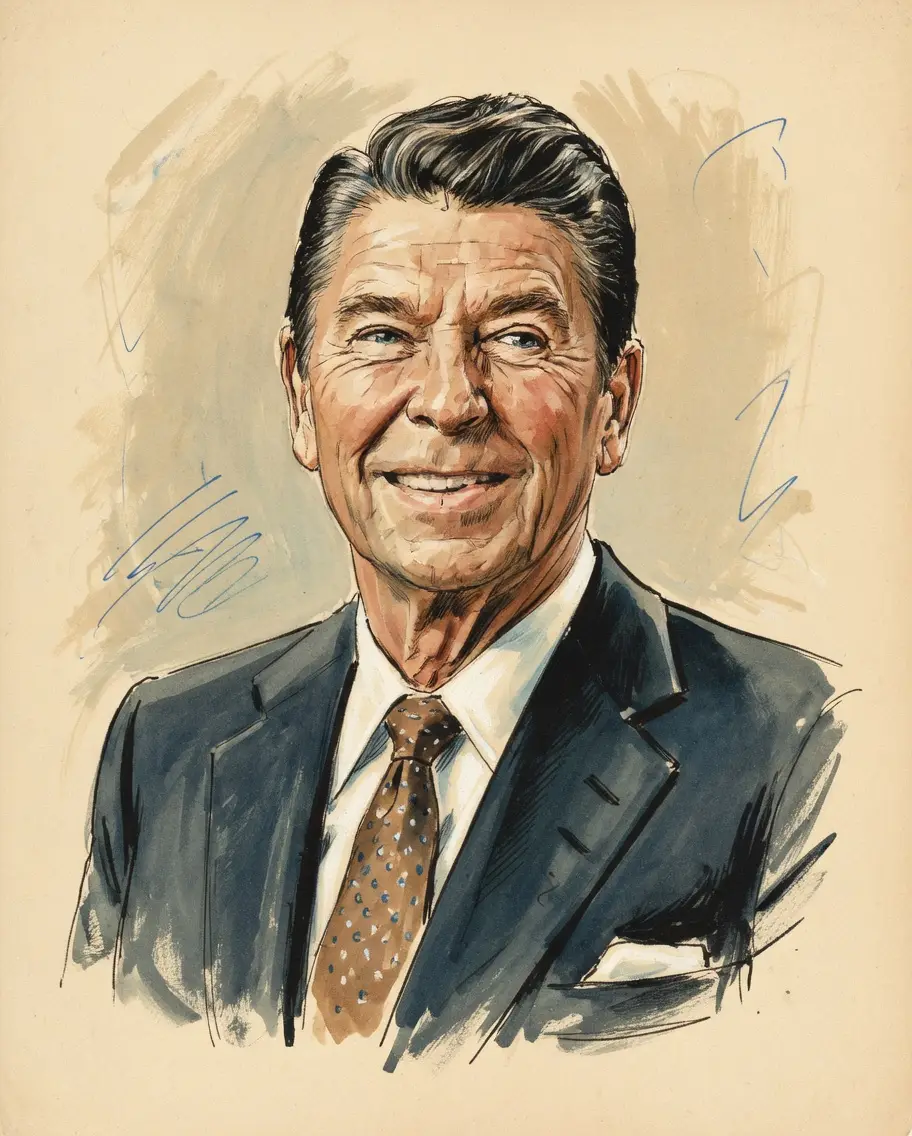
Ronald Reagan on Leadership
TL;DR
Ronald Reagan believed great leadership hinged on articulating a compelling, visionary goal and empowering people to achieve it.
Key Points
The greatest leader is the one who gets people to do the greatest things, not necessarily the one who does the greatest things himself.
He stated that to grasp and hold a vision is the very essence of successful leadership, applicable everywhere from Hollywood to governance.
A leader must surround himself with the best people, delegate authority, and avoid interfering as long as the agreed-upon policy is being carried out.
Summary
Ronald Reagan's approach to leadership is often characterized as charismatic, requiring a clear, compelling vision that followers can internalize and act upon. He believed the leader's primary role was to define this idealized vision—often one of conservative principles like individual freedom and smaller government—and then effectively communicate it with passion and vigor, using symbolism and emotional appeals. A crucial element was his ability to connect with the public, often utilizing humor and optimism to disarm critics and restore national confidence, especially during times of perceived crisis. This style, sometimes seen as a U-Turn from the status quo, resonated deeply with a populace seeking change.
Beyond communication, Reagan emphasized translating that vision into management by centralizing personnel selection while delegating authority, operating under the mantra that "Personnel is policy." He demonstrated an extraordinary trust in his team, avoiding micromanagement as long as policies were being executed, which empowered subordinates. Furthermore, he viewed compromise as a necessary tool for advancement rather than a failure, learning to fight hard but accept agreements strategically to secure future gains. His willingness to take ultimate responsibility, even for administration mistakes, reinforced the integrity and trust followers attributed to his leadership.
Key Quotes
The greatest leader is not necessarily the one who does the greatest things. He is the one that gets the people to do the greatest things.
The greatest leader is not necessarily the one who does the greatest things. He is the one that gets the people to do the greatest things.
Frequently Asked Questions
Ronald Reagan's core philosophy centered on the power of vision and communication. He believed that articulating an ideological vision, supported by convictions and moral courage, was paramount for a leader. He felt this vision empowered followers to achieve great things themselves.
The former president was known for centralizing personnel selection but strongly favored delegating authority to his team, operating on the principle that personnel management was central to execution. He avoided micromanagement, preferring to focus on the larger picture so long as his established policy was being enacted.
Reagan exemplified traits like durable optimism, integrity, and skillful use of humor to manage impressions and disarm critics. He also demonstrated a capacity for compromise to advance long-term goals, which was a lesson learned from his early career as a negotiator.
Sources7
Ronald Reagan Quotes About Leadership | A-Z Quotes
15 Reagan Leadership Lessons - James Strock
Ronald Reagan Quotes | The Ronald Reagan Presidential Foundation & Institute
Charismatic Leadership Case Study with Ronald Reagan as Exemplar
Lessons in Leadership from Ronald Reagan - Kevin Paul Scott
Reagan on Leadership: Executive Lessons from the Great Communicator Audiobook
Quote by Ronald Reagan: “The greatest leader is not necessarily ...”
* This is not an exhaustive list of sources.