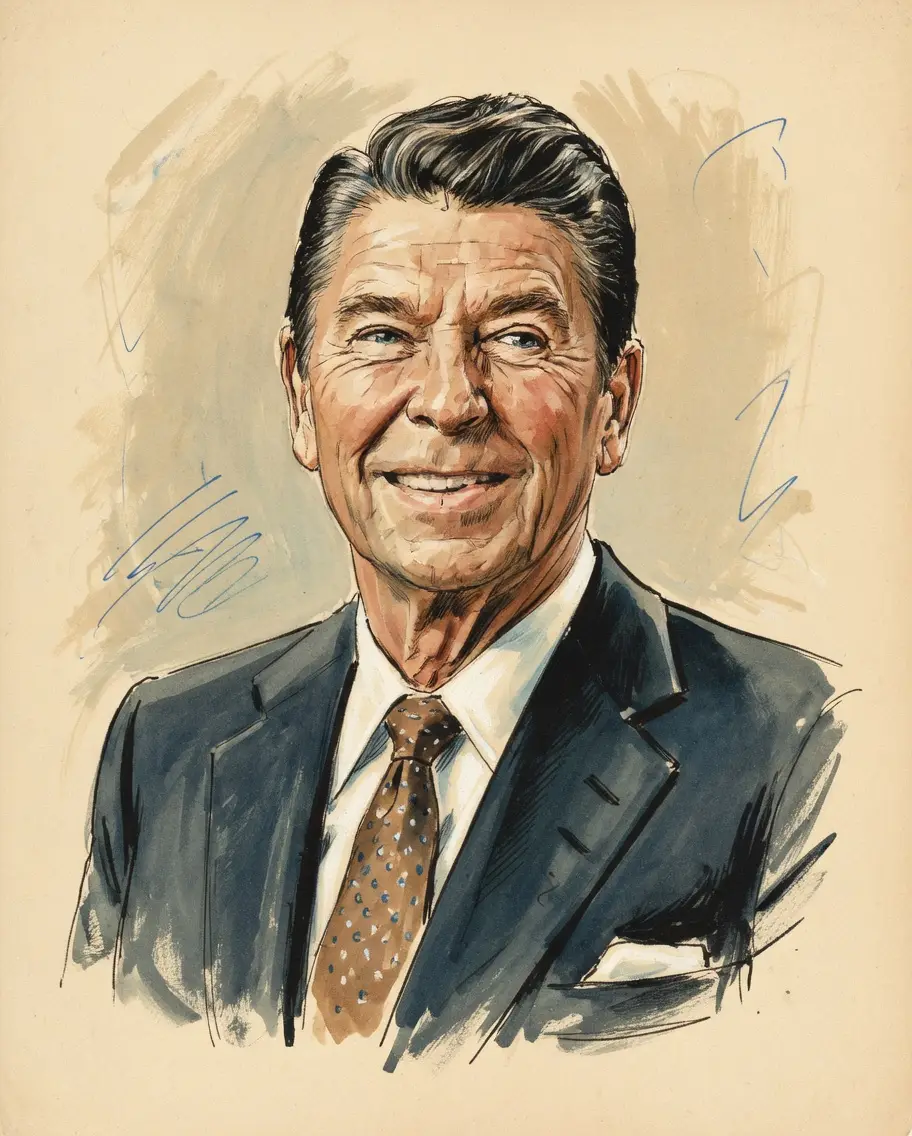
Ronald Reagan on Capitalism
TL;DR
Ronald Reagan strongly championed free-market capitalism as the superior system for creating prosperity and individual wealth for all citizens.
Key Points
He signed the Economic Recovery Tax Act of 1981 to reduce individual income tax rates and incentivize small businesses.
He believed government's main role was to nurture individual genius by minimizing its drain on the economy and avoiding interference.
He advocated for expanded capital participation, utilizing Employee Stock Ownership Trusts to allow workers to own productive capital in 1974.
Summary
Ronald Reagan's core position viewed capitalism as the economic system most aligned with individual liberty and the engine for national prosperity, contrasting it sharply with socialism. He advocated for policies that would unleash the entrepreneurial spirit by cutting taxes, lowering regulation, and reducing government interference in the economy. He believed that empowering individuals financially and providing investment incentives would directly lead to job creation, control inflation, and foster the "American dream" by allowing all citizens to share in the bounty of a revived economy.
His approach involved implementing reforms to reduce government's drain on the economy, reserving federal action only for functions requiring national attention, and promoting privatization where the private sector could perform services more efficiently. Reagan promoted expanded capital ownership, notably through mechanisms like Employee Stock Ownership Trusts, to broaden participation in the capitalist system beyond just labor income. He consistently argued that this system, which rewards risk and innovation, was triumphant over centralized, state-controlled economies.
Key Quotes
And by reducing taxes and regulatory bureaucracy, we have unleashed the creative genius of ordinary Americans and ushered in an unparalleled period of peacetime prosperity.
Frequently Asked Questions
Ronald Reagan was a strong advocate for capitalism, viewing it as the economic system that unleashed human energy and genius better than any alternative. He believed free-market principles were essential for individual fulfillment, economic growth, and creating prosperity for all Americans. He frequently positioned it as the necessary counterpoint to socialism.
As president, he implemented policies aimed at stimulating the free market by cutting taxes and reducing government regulation and bureaucracy. His administration also focused on controlling the rate of government spending to alleviate the drain on the economy. These actions were intended to restore incentives for production and entrepreneurship.
Yes, Ronald Reagan argued that capitalism could make everybody a 'have' rather than just shifting wealth between groups. He promoted plans to broaden the ownership of productive capital, such as through Employee Stock Ownership Trusts, so workers would have a stake in the system's success. He contended that the resulting economic expansion created millions of jobs and increased net worth across various income brackets.
Sources5
Economic Policy | The Ronald Reagan Presidential Foundation & Institute
Reagan on ESOPs - ESOP Services, Inc.
Capitalism Lifts People Up, Socialism Holds Them Down
The Ten Legacies of Ronald Reagan | Hoover Institution
Letter to the Speaker of the House of Representatives and the President of the Senate Transmitting the Annual Economic Report of the President
* This is not an exhaustive list of sources.