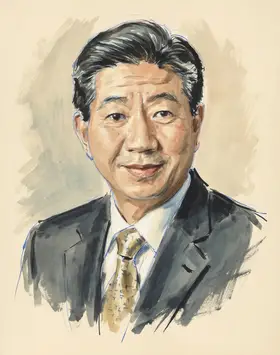
Roh Moo Hyun on North Korea
TL;DR
Roh Moo Hyun strongly pursued a Policy for Peace and Prosperity based on engagement, dialogue, and economic cooperation with the North.
Key Points
He defined North Korea not as the 'main enemy' (jujeok) in official documents, but as an impoverished partner for reunification, removing that designation from the 2005 Defense White Paper. [cite: 1.3]
During the second inter-Korean summit in October 2007, he agreed with the North Korean leader to establish a Special Peace and Cooperation Zone in the West Sea. [cite: 1.1]
He opposed sanctions against North Korea concerning its nuclear program, stating that sanctions would be 'very, very dangerous' during his 2005 meeting with the U.S. President. [cite: 1.3]
Summary
Roh Moo Hyun, upon taking office in February 2003, established the 'Policy for Peace and Prosperity,' which aimed to build a 'structure of peace' on the Korean Peninsula by expanding upon his predecessor's engagement strategy. His core position was built on the belief that political, economic, and security cooperation with North Korea was the path to eventual peaceful unification, prioritizing reconciliation over confrontation. Key evidence of this approach included pushing forward major economic projects like the Kaesong Industrial Complex and linking crucial road and rail lines, even amid tensions like the North Korean nuclear crisis. [cite: 1.3]
His approach to security, particularly concerning the highly contentious Northern Limit Line (NLL), involved attempts at desecuritization, suggesting the NLL was an ideational structure, not an unchangeable territorial border. This vision was documented in the October 4th Declaration after his 2007 summit with the North Korean leader, which proposed a Special Peace and Cooperation Zone in the West Sea. However, this policy faced significant domestic opposition from conservatives who viewed the NLL as a territorial border and resisted any perceived weakening of security, ultimately frustrating the full realization of Roh's vision before his term ended. [cite: 1.1]
Key Quotes
I'm worrying the opposition that maybe I cannot continue the presidency while I get that much of it.
Frequently Asked Questions
Roh Moo Hyun's core policy was the 'Policy for Peace and Prosperity,' which aimed to build a structure of peace through dialogue, engagement, and economic cooperation with the North. He believed this engagement strategy was essential for de-escalating tensions and creating a foundation for eventual peaceful unification. This required recognizing the North as a partner rather than an adversary.
No, his approach often caused friction with the U.S., particularly under the Bush administration, which favored a harder line. Roh opposed sanctions and focused on fostering inter-Korean dialogue, even as Washington prioritized denuclearization demands first. This led to differing views on how to manage North Korea's nuclear ambitions. [cite: 1.7]
The former president attempted to 'desecuritize' the NLL, arguing it was unilaterally drawn and not an official territorial border, which was contrary to established South Korean conservative positions. He proposed establishing a 'West Sea Peace Zone' as part of broader confidence-building measures. This desecuritization attempt caused a domestic political split. [cite: 1.1]
Sources7
Untying the “Gordian Knot”? Northeast Asian Security Complex and Desecuritization of the Northern Limit Line
South-North Korean Relations Under The Roh Moo-Hyun Government
The President's News Conference With President Roh Moo-hyun of South Korea in Gyeongju, South Korea
Roh Moo-hyun - Wikipedia
Peace on a Knife's Edge: The Inside Story of Roh Moo-hyun's North Korea Policy
We Need To Make North Korea a Big Deal
The Roh Moo-Hyun Administration's Policy toward North Korea
* This is not an exhaustive list of sources.