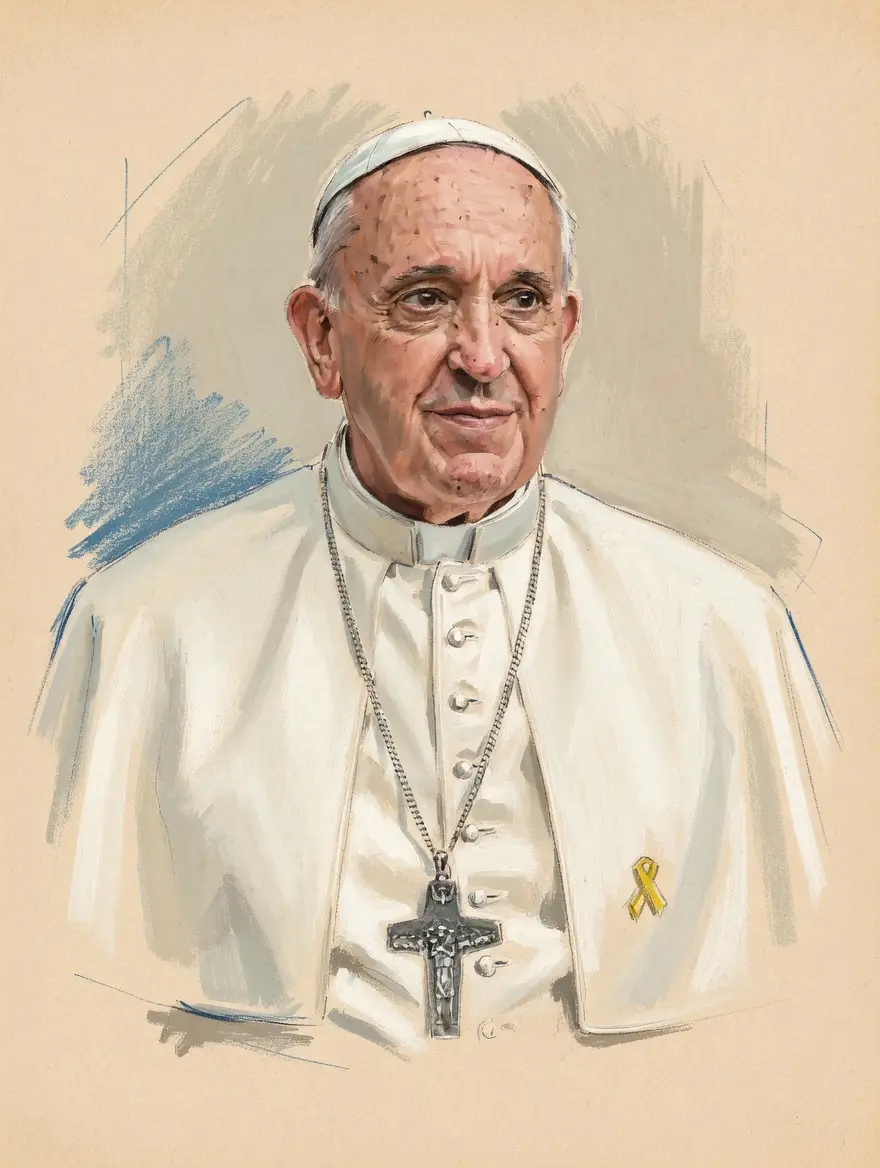
Pope Francis on Communism
TL;DR
Pope Francis condemns the ideology of Communism while defending his focus on the poor as purely Gospel-based, not Marxist.
Key Points
He stated in an interview that if the Gospel is viewed only through a sociological lens, then Jesus would be considered a communist, but he clarified this is not his theological position.
He has actively criticized the use of Marxist concepts in analysis, specifically labeling movements like liberation theology as an 'ideological exploitation' of the Church.
He defended his frequent critique of economic systems by asserting that caring for the poor is the 'touchstone' of the Gospel, not a communist invention, citing Church Fathers from the second and third centuries.
Summary
Pope Francis has consistently rejected Communism as an ideology, clarifying that his strong focus on caring for the poor and criticizing aspects of globalized capitalism is rooted in Catholic Social Teaching and the Gospel, not Marxist concepts. He has addressed accusations of Marxist sympathies by stating that while he rejects the ideology, he recognizes that some individuals drawn to Communism share a Christian desire for justice for the marginalized, suggesting, in one instance, that in a purely sociological reading of the Gospel, Jesus himself might align with communist principles, though this is highly qualified and disputed by critics. He has specifically criticized the ideological exploitation of the Church through movements like liberation theology which incorporated Marxist analysis. He maintains that the Church’s preferential option for the poor is distinct from political ideologies and has been a core tenet for centuries, citing early Church Fathers whose words on wealth distribution sound radical today.
His position is contextualized by his Argentinian background, where he saw leftist movements advocating for the poor against oppressive regimes, which may explain his nuanced dialogue with socialist-leaning groups. Nevertheless, he draws a sharp line between the concern for human welfare and the atheistic, anti-individual rights foundation of official Communism, which has historically led to mass atrocities. He has noted that while capitalism has lifted some from poverty, it has created new inequalities and a culture of waste, which is why he continues to call for structural changes that prioritize human welfare over the idolization of money and markets.
Key Quotes
If I see the Gospel in a sociological way only, yes, I am a communist, and so too is Jesus. Behind these Beatitudes and Matthew 25 there is a message that is Jesus' own. And that is to be Christian. The communists stole some of our Christian values.
"It it has been said many times and my response has always been that, if anything, it is the communists who think like Christians. Christ spoke of a society where the poor, the weak and the marginalized have the right to decide. Not demagogues, not Barabbas, but the people, the poor, whether they have faith in a transcendent God or not. It is they who must help to achieve equality and freedom".
"Caring for our neighbor, for those who are poor, who suffer in body and soul, for those who are in need: this is the touchstone. Is it pauperism? No. It is the Gospel."
Frequently Asked Questions
Pope Francis is unequivocally against Communism as a political ideology, which he views as incompatible with Catholic teaching due to its atheism and suppression of individual dignity. However, he often distinguishes the rigid political structure from the genuine desire for social justice that he sometimes observes in individuals who align with socialist or communist ideals.
The Pope has not changed his fundamental opposition to the atheistic and materialistic core of Marxist philosophy. His stance has remained consistent in criticizing both unbridled capitalism and state-controlled Communism, framing his concern for the poor as faithful to Catholic tradition rather than being a shift toward Marxist sympathy.
Pope Francis once remarked that, if anything, it is the communists who think like Christians regarding the poor and marginalized. He explained this by noting that the Gospel mandates service to the needy, a value that he believes communists have 'stolen' or adopted without adhering to the full theological framework.
Sources8
Pope Francis: To Care for the Poor is Not Communism, It is ...
Pope Francis: Mixing 'Marxist concepts' with Catholic ...
Pope Francis: “If I See the Gospel in a Sociological Way ...
Pope Francis says "it is the communists who think like ...
Pope Francis defends himself against communism claims
Why is Pope Francis Working with Communists?
Does Pope Francis really believe that 'Communists think ...
Pope Francis: Concern for poor is sign of Gospel, not red ...
* This is not an exhaustive list of sources.