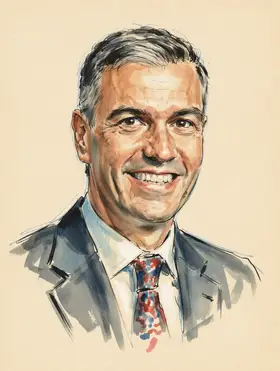
Pedro Sánchez on Russia
TL;DR
Pedro Sánchez views Russia as a destabilizing force globally, strongly opposing its wars and advocating for UN reform.
Key Points
He considers both Russia and the U.S. as countries bringing instability to the world through their respective wars in Ukraine and Iran, as of March 2026.
The Spanish Prime Minister has called for the elimination of the right of veto in the United Nations Security Council to reform the global body.
He asserted in March 2026 that an aggressive U.S. action on Greenland, which would please Vladimir Putin, could harm NATO's existence.
Summary
Pedro Sánchez has maintained a consistently strong stance against Russia's actions, particularly framing its involvement in international conflicts as a major source of global instability. He has explicitly linked Russia’s conduct, such as its war in Ukraine, to the outdated structure of the UN Security Council, where he finds it "curious" that both Russia and the United States maintain permanent member status while contributing to global conflict. His position is characterized as rooted in principle and respect for international law rather than mere political calculation, a stance he has defended against domestic critics.
This stance extends to broader implications for international order, with the Spanish Prime Minister arguing that the values of the European Union must remain steadfast even as the world changes. He has called for fundamental reform of the United Nations, including the elimination of the veto power in the Security Council, to create a body more reflective of contemporary global actors like India and Brazil. Furthermore, he has drawn parallels between Russian aggression and potential moves by other powers, suggesting that actions like a U.S. move on Greenland could be seen as a justification or a "gift to Putin," thereby threatening the stability of alliances like NATO.
Frequently Asked Questions
Pedro Sánchez considers Russia a significant source of global instability, primarily due to its involvement in international conflicts like the war in Ukraine, according to statements in March 2026. He frames Spain's opposition to such actions as a principled stand based on international law. This opposition is a cornerstone of his current foreign policy stance.
The available information presents Pedro Sánchez's current opposition to Russia's actions as rooted in consistent foreign policy principles, not suggesting a change in his core stance. He has defended his government's 'no to war' position as reflective of long-held values. This perspective has been consistently applied to recent conflicts, including Ukraine.
The Prime Minister stated in March 2026 that it is 'curious' Russia retains permanent member status on the UN Security Council given its role in conflicts like Ukraine. He argues that this structure, which includes Russia and the US, is unrepresentative and needs reform, specifically by ending the right of veto. This reform is intended to make the UN better reflect the contemporary world order.
Sources4
Spain's 'no to war' stance rooted in principles, not politics: Premier Sanchez
Sanchez: Spain's 'no to war' stance rooted in principles, not politics
Spanish Prime Minister Pedro Sanchez doubled down on his opposition to the attac...
Spanish PM Sanchez: A US Grab for Greenland is a 'Gift to Putin'
* This is not an exhaustive list of sources.