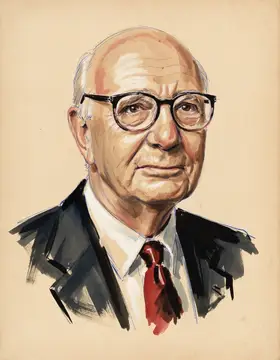
Paul Volcker on Stagflation
TL;DR
Paul Volcker viewed stagflation as a crisis requiring decisive, aggressive monetary tightening to crush entrenched inflation expectations.
Key Points
He announced a major shift in operating procedures in October 1979 to target reserve growth, moving away from managing the federal funds rate directly.
He stated that long-term economic stability required dealing with the inflationary situation, as inflation and unemployment rates were linked over time.
The aggressive tightening led to the economy entering a recession in 1981-1982, which lasted until November 1982, while inflation began its decline.
Summary
Paul Volcker, as Federal Reserve Chairman, confronted the severe stagflation of the late 1970s and early 1980s, which was characterized by high inflation coexisting with slow growth and high unemployment. He believed this entrenched inflation, fueled by public expectations, was the primary threat to long-term economic stability, despite the painful short-term costs associated with combating it. Evidence of this stance came in October 1979 when he announced a dramatic operational shift to target reserve growth, rather than the federal funds rate, to gain firmer control over the money supply and decisively break inflationary momentum.
The implication of his policy was a necessary, albeit painful, sacrifice of short-term economic activity to restore price stability. Volcker persisted with this tight monetary policy, raising the federal funds rate to record highs, even when the economy entered a recession and faced public criticism from political figures. By staying the course through the 1981-1982 downturn, he successfully arrested the insidious rise of prices, ultimately re-establishing the Federal Reserve's credibility and setting the stage for the subsequent period of low inflation known as the Great Moderation.
Frequently Asked Questions
Paul Volcker's main strategy to combat the stagflation of the late 1970s was to aggressively tighten monetary policy to bring down inflation. He believed that breaking entrenched inflation expectations was necessary, even if it meant causing short-term economic pain. This involved raising interest rates to historically high levels to slow the growth of the money supply.
During the period of stagflation, Volcker ultimately prioritized fighting inflation, viewing it as essential for long-term economic health and the achievement of both parts of the Federal Reserve's dual mandate. While he acknowledged the cost in terms of higher unemployment, he argued that persistent inflation made the long-term outlook worse for both inflation and joblessness.
In the short term, Volcker's actions caused significant economic disruption, including sharply rising interest rates and two recessions, one in 1980 and a more severe one from 1981 to 1982. Unemployment peaked near 11 percent during this period as the Federal Reserve maintained its tight stance to ensure the fight against inflation was successful.
Sources6
Volcker's Announcement of Anti-Inflation Measures | Federal Reserve History
From Stagflation to the Great Moderation - Federal Reserve Bank of ...
Stagflation in the 1970s | Video Assignment | Federal Reserve Education
Paul Volcker Taught Us How Tax And Monetary Policy Can Work Together To Enhance Growth | Tax Policy Center
Inflation is soaring. How did Paul Volcker's Federal Reserve tackle it 40 years ago? : r/Economics
* This is not an exhaustive list of sources.