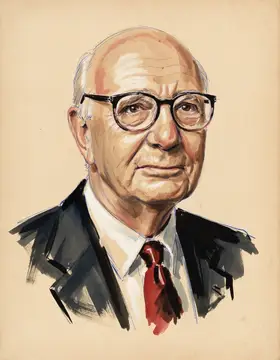
Paul Volcker on Federal Reserve
TL;DR
Paul Volcker strongly advocated for an independent Federal Reserve, using aggressive disinflationary policy to restore price stability.
Key Points
He announced a dramatic break in operating procedures in October 1979, shifting focus to managing bank reserves to combat double-digit inflation.
During his tenure, US inflation, which peaked at 14.8 percent in March 1980, fell below 3 percent by 1983 due to tight monetary policy.
He argued that the Federal Reserve's strength lies in its independence, comparing it to the need for judges to be free from political pressures.
Summary
Paul Volcker's core position on the Federal Reserve centers on the absolute necessity of its independence from political pressure, viewing it as crucial for effective monetary policy execution. The key evidence for this stance lies in his tenure as Chairman (1979–1987), where he pursued an aggressive interest rate hiking cycle, known as the Volcker shock, to break the back of rampant inflation, which peaked over 13%. This action, though causing a deep recession, re-established the Fed's credibility for low inflation, proving his commitment to the central bank's mandate over political expediency.
He consistently valued the System's regional structure, believing it bolstered its non-political nature, and he resisted efforts that he felt would centralize control or weaken the regional banks' roles. His belief that judges and central bankers should make decisions based on law and mandate, rather than politics, was reinforced by his experience facing criticism from the President and Congress while combating inflation. He saw Federal Reserve independence as vital to preventing monetary policy from being manipulated for short-term political gain.
Frequently Asked Questions
Paul Volcker's overriding focus as Chairman was to aggressively combat the high and volatile inflation that characterized the late 1970s and early 1980s. He implemented tight monetary policy to bring inflation under control, even at the cost of a significant, though temporary, economic recession. He believed this difficult action was necessary to restore the central bank's credibility.
Yes, Paul Volcker was a fierce defender of the Federal Reserve's independence from political influence. He felt that the institution's ability to make unpopular but economically necessary decisions, like raising interest rates during a downturn, depended entirely on its separation from the political process.
He believed the Federal Reserve's regional structure, with participation from regional Bank presidents, was an important element that strengthened its non-political character. He expressed concern that over-centralization or changes to the structure could weaken the institution's independence and historical roots.
Sources5
Volcker's Announcement of Anti-Inflation Measures | Federal Reserve History
Column: Paul Volcker’s legacy, an independent Federal Reserve, is under threat
Paul Volcker - Wikipedia
Federal Reserve Board Oral History Project: Interview with Paul A. Volcker
Interview with Paul A. Volcker | Federal Reserve Bank of Minneapolis
* This is not an exhaustive list of sources.