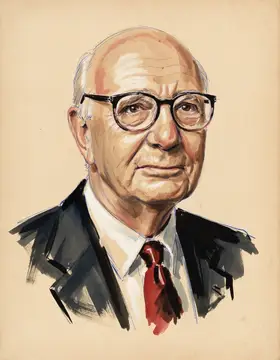
Paul Volcker on Economy
TL;DR
Paul Volcker believed aggressively prioritizing price stability through monetary restraint was essential for long-term economic health.
Key Points
He announced new measures in October 1979, shifting focus to managing bank reserves to rein in inflation.
He opposed the dual mandate of inflation and unemployment, believing price stability was the Fed's best long-term contribution to the economy.
He championed the Volcker Rule, asserting that deposit-taking institutions should be limited in their proprietary trading activities.
Summary
Paul Volcker's core economic position was defined by his tenure as Federal Reserve Chairman, where he made fighting high inflation his absolute top priority. Evidence of this stance is his implementation of the "Volcker shock," which involved highly restrictive monetary policy, including raising the federal funds rate to a peak of 20 percent by late 1980, to curb inflation that reached nearly 15 percent. He rejected gradualism, believing that the distortions caused by persistent inflation necessitated forceful action, even if it caused short-term economic hardship, such as a recession and high unemployment.
He expressed skepticism about a "new paradigm" economy and later criticized the dual mandate of the Federal Reserve, arguing it confused policy by implying a perpetual trade-off between inflation and unemployment. Volcker maintained that the best contribution the Fed could make to the economy over time was to maintain price stability. Furthermore, post-Fed, he advocated for financial reform, particularly favoring the Volcker Rule to separate commercial banking from risky proprietary trading, viewing the latter as a cultural and risk issue for essential financial institutions.
Key Quotes
Double-digit inflation is a terrible thing - and it got up to 14 or 15 percent on a monthly basis for a while, shortly after I became chairman of the Fed.
Frequently Asked Questions
Paul Volcker's primary economic focus was ensuring price stability by decisively combating inflation. He implemented aggressive, high-interest-rate policies, known as the Volcker shock, to break entrenched inflationary expectations. He believed this commitment to low inflation was the single most important service the central bank could provide for long-term prosperity.
Yes, his policies were intentionally restrictive and led to a severe recession in the early 1980s, with the unemployment rate peaking above 10 percent. Volcker felt this short-term pain was necessary to stop the greater long-term damage caused by sustained high inflation. He noted that distortions from inflation meant a recession was likely inevitable anyway.
He was against the dual mandate requiring the Fed to target both inflation and employment simultaneously. Volcker felt this confused the public and implied that monetary policy could solve all structural economic problems. He strongly preferred focusing solely on achieving and maintaining price stability.
Sources5
Volcker's Announcement of Anti-Inflation Measures
Paul Volcker - Wikipedia
An Interview with Paul Volcker
First Measured Century: Interview: Paul Volcker - PBS
Inflation is soaring. How did Paul Volcker's Federal Reserve tackle it 40 years ago? : r/Economics
* This is not an exhaustive list of sources.