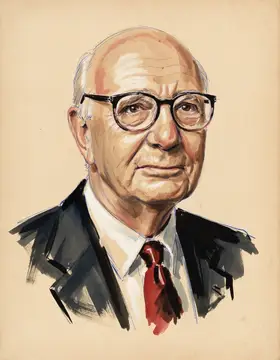
Paul Volcker on Bretton Woods
TL;DR
Paul Volcker believed current global interdependence demanded a new Bretton Woods-style international cooperation and coordination framework.
Key Points
He led the Bretton Woods Commission, which advocated for policy coordination between the US, Germany, and Japan in 1994.
Volcker suggested that today's mutual interdependence requires a higher degree of international cooperation similar to Bretton Woods ideals.
During his Treasury service (1969-1974), he was involved in the events leading to President Nixon’s suspension of dollar convertibility to gold in 1971.
Summary
Paul Volcker, reflecting on the collapse of the original Bretton Woods system, expressed a belief that contemporary global economic interdependence necessitates a high degree of international cooperation and coordination among major economic powers. He saw the spirit of the original Bretton Woods ideals, which sought greater global economic stability, as relevant to modern challenges, despite acknowledging the flaws of the fixed exchange rate system. His position was not a call for a rigid return to the 1944 agreement but rather an appeal for a modern framework to manage international monetary affairs.
He was instrumental in leading the Bretton Woods Commission in the 1990s, which proposed a system featuring policy coordination among the monetary authorities of the US, Germany, and Japan to limit excessive exchange rate volatility. This suggested structure aimed for flexible exchange rate bands managed through coordinated policy rather than fixed parities. Volcker’s advocacy underscored his conviction that the world's financial architecture required renewed commitment to multilateralism to prevent market excesses and ensure global economic health.
Frequently Asked Questions
Paul Volcker recognized the stability and favorable macroeconomic performance, including lower inflation variability, that characterized the Bretton Woods era. However, he was also aware of its weaknesses, such as the incompatibility of fixed exchange rates with domestic economic goals.
Paul Volcker called for a modern agreement based on mutual interdependence, suggesting a system where major monetary authorities coordinate policy to avoid excessive exchange rate volatility. This proposal aimed for managed flexibility rather than the rigid fixed rates of the original system.
Yes, Paul Volcker was significantly involved, serving as the chairman for the Bretton Woods Commission starting in October 1993. The committee aimed to propose a new system of foreign exchange rates that would not be entirely left to market forces.
Sources5
Paul A. Volcker Addresses the Bretton Woods Committee's Annual Meeting
The late Paul Volcker
Do We Need a New Bretton Woods?
The Great Inflation | Federal Reserve History
Paul Volcker - Wikipedia
* This is not an exhaustive list of sources.