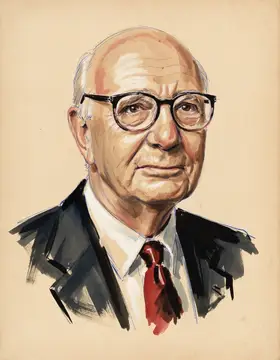
Paul Volcker on Austerity
TL;DR
Paul Volcker implemented severe monetary contraction to conquer inflation, causing a deep, painful recession.
Key Points
He oversaw a program of financial austerity after taking the Federal Reserve Chair post in August 1979 to combat rampant inflation.
The policy involved raising interest rates to levels topping 20% in 1980, leading to a sharp economic contraction and high unemployment.
The extreme tightening eventually succeeded in bringing inflation below 4 percent by 1983, laying groundwork for a quarter century of low inflation.
Summary
Paul Volcker, as Chairman of the Federal Reserve from 1979 to 1987, oversaw a policy of significant monetary tightening that is often characterized as a form of financial austerity, popularly termed the "Volcker Shock." Appointed to combat the decade-long "stagflation" of the 1970s, he chose to break wage-price spirals by contracting the money supply, allowing interest rates to rise to unprecedented levels, topping out over 20% in 1980. This action was deemed necessary to restore confidence in the dollar and vanquish runaway inflation expectations, even though it triggered what was then the deepest economic downturn since the Great Depression, with unemployment peaking at 10.8 percent and causing widespread business bankruptcies.
This deliberate, painful contraction was executed with the political support of the sitting president, who recognized the long-term necessity despite the short-term economic anguish it caused. While the policy succeeded in slaying inflation, reducing it to around 2 percent by 1983, critics noted the harsh immediate social and industrial consequences, including the devastation of the 'Rust Belt.' Furthermore, subsequent analysis suggests that while Volcker's actions crushed inflation, his triumph also planted seeds for future financial instability by fostering an era of low inflation and increased risk appetite.
Key Quotes
We are not — at least I am not — proposing that we go to a purely mechanical reserve targeting approach. […] There are all these elements of judgment that enter into the process. That, combined with the constraint on the federal funds rate, brings us to something of a hybrid.
it was time to act—to send a convincing message to markets and to the public.
Frequently Asked Questions
Paul Volcker did not explicitly label his anti-inflationary actions as 'austerity,' but his policy was a form of severe monetary contraction. He believed that to conquer entrenched inflation, short-term costs, including a significant economic downturn, were necessary for long-term benefits. He prioritized price stability above immediate employment concerns during that period.
Yes, the measures Volcker implemented, known as the 'Volcker Shock,' were extremely harsh, causing a major recession and widespread business failures. Some observers argue that the Fed could have broken inflation with less drastic action, but Volcker maintained that the severity was required to send a convincing signal to markets and the public.
Volcker's policy was a monetary austerity, using dramatically high interest rates to choke off the money supply and curb inflation. This is distinct from traditional fiscal austerity (government spending cuts), but both approaches involve prioritizing inflation control or fiscal health over supporting short-term economic growth and employment.
Sources8
The ripple effect of the Volcker Shock for the economy | JMGshortcuts
Chapter 31: The 'Volcker Shock' and Start of the Neoliberal Era – A Critique of Crisis Theory
Paul Volcker's pragmatism: fighting inflation and financialization
The World Paul Volcker Made
Paul Volcker: The Man Who Helped Reagan Save the Economy
Inflation should not change how policymakers respond to recession
Robert Samuelson on Paul Volcker and the Great Inflation
The Volcker Myths
* This is not an exhaustive list of sources.