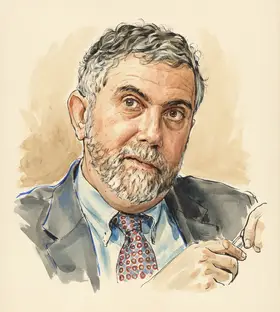
Paul Krugman on Trade
TL;DR
Paul Krugman strongly advocates for rules-based free trade, arguing it generally increases global wealth despite creating domestic winners and losers.
Key Points
His Nobel-winning research focused on New Trade Theory, emphasizing economies of scale and product differentiation as drivers of trade between similar countries.
He strongly opposes using bilateral trade deficits as a metric for trade policy, calling such a concern "completely ignorant" in 2024.
He argued that the chaotic tariffs imposed by a former president inflict economic damage by raising prices and creating uncertainty, rather than achieving stated policy goals.
Summary
Paul Krugman is a proponent of international trade, grounding his views in both classical and his own New Trade Theory (NTT). His Nobel Prize-winning work emphasized that trade is beneficial not only due to traditional comparative advantage (differences between countries) but also due to economies of scale and product differentiation within industries. This NTT helps explain the large volume of trade between similar, advanced economies, suggesting that specialization on a large scale benefits all parties involved. He views the post-World War II, rules-based trading system, architected by the United States, as having fostered global wealth and peace.
However, he acknowledges that the modern, hyper-globalized system has negative distributional consequences, primarily hurting lower-skilled workers in advanced nations through job displacement in specific, localized industries. While he asserts that the overall world economy is richer, he criticizes purely protectionist arguments, such as focusing on bilateral trade deficits as inherently bad. He contends that recent, chaotic tariff policies, like those imposed by a former president, inflict damage by raising prices, creating uncertainty, and eroding US credibility in the international system, suggesting such unilateral actions are economically destructive and politically counterproductive.
Key Quotes
If I had been in charge of negotiating with the European Union, I would have been able to get a deal with the following components: · Very low tariffs on U.S. exports of manufactured goods to Europe, on the order of 1 percent · Near balance in bilateral trade, with U.S. exports to Europe close to 90 percent of our imports from Europe · U.S. companies allowed to operate freely in Europe, earning hundreds of billions a year in profits · European corporations investing more than $150 billion a year — real investment, not loans — in the United States
Frequently Asked Questions
Paul Krugman is a strong advocate for international trade, believing it generally makes the world economy richer through specialization and scale effects. He supports a rules-based system that minimizes trade barriers. However, he recognizes that trade liberalization can cause painful, localized dislocations for workers in advanced economies.
No, Paul Krugman argues that focusing on trade deficits due to tariffs is largely misplaced. He explains that trade balances are fundamentally linked to capital flows; thus, tariffs' impact on deficits is uncertain and often offset by exchange rate appreciation. He noted that in practice, past tariff hikes did not significantly reduce the trade balance.
New Trade Theory, which Krugman helped develop, explains why countries that are similar trade extensively with each other. It posits that trade is driven by the advantages of specialization and large-scale production (increasing returns) within industries, in addition to traditional comparative advantage between industries.
Sources6
How We Lost the Trade War
Paul Krugman: Globalization and international trade | Gerald R. Ford School of Public Policy
Paul Krugman On Trade, Tariffs, & America's Role In The Global Economy
Can Trump Reduce the Trade Deficit?: Paul Krugman
Rethinking International Trade
* This is not an exhaustive list of sources.