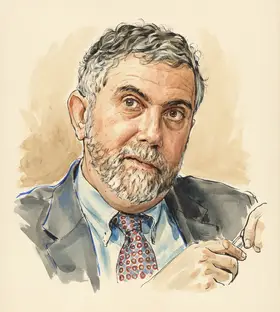
Paul Krugman on Neoliberalism
TL;DR
Paul Krugman views neoliberalism as an ideology whose core tenets have contributed to rising inequality and failed to deliver broad economic growth.
Key Points
He argued that the laissez-faire absolutism promoted by neoliberals has led to an intellectual climate where faith in markets and disdain for government often trump the evidence.
He specifically noted that key elements of the neoliberal policy shift after 1980, such as slashing taxes on the rich and breaking unions, were not necessary to bring down inflation.
He views the ideology as often being an anti-state stance that masks the reality that neoliberalism frequently requires a strong state to enforce market-based reforms.
Summary
Paul Krugman is positioned as a strong critic of the post-1980 "neoliberal policy revolution," which he associates with sharp cuts in top marginal tax rates, deregulation, and privatization. He argues that the resulting focus on market fundamentalism, where faith in markets and disdain for government often trumps evidence, has contributed to increased economic inequality, citing the stagnation of real incomes for most workers relative to the top earners in the preceding post-war era. While acknowledging that some specific policy changes within the broader neoliberal framework, such as certain trade liberalization measures, might have had merits or were even bipartisan, Krugman maintains that the overall ideological shift undermined economic performance for the majority and led to a plutocracy. He has specifically criticized banking deregulation as having gone poorly and contributing to financial instability, contrasting this with the more stable post-1945 economic model.
He suggests that the neoliberal movement in the United States was sustained by a political alignment that favored wealthy elites and corporations, resulting in policies that benefited the very rich while simultaneously reducing the social safety net and public investment in areas like research and infrastructure. The economic framework of neoliberalism, in his view, is distinct from the classical liberal ideal because it often requires significant state intervention to implement market-like reforms across all areas of life. Though he has been called a loyal opposition to the more vicious elements of neoliberalism, he ultimately rejects the core neoclassical economic precepts underpinning the ideology, arguing that its focus on market efficiency often neglects crucial social factors and has led to a system that socializes costs while privatizing profits.
Key Quotes
If you can’t explain something in simple terms, you don’t understand it
Frequently Asked Questions
Paul Krugman is a strong critic of Neoliberalism, particularly the policy shifts that gained prominence after the late 1970s and early 1980s. He contends that the ideology, characterized by deregulation and tax cuts for the wealthy, has exacerbated economic inequality.
While his fundamental critique of neoliberal policies leading to inequality remains, his analysis adapts to specific economic contexts, such as the COVID-19 slump, indicating a pragmatic application of economic theory rather than adherence to a fixed, abstract ideological stance.
The Nobel laureate argued that many of the post-1980 reforms, like breaking unions and major tax cuts for the rich, were not necessary responses to economic problems like inflation. He believes the preceding economic model delivered better growth for the median worker.
Sources9
What does Krugman think of the neoliberal policy revolution?
Burying Neoliberalism
How Republican Economic Policies Promote Inequality
Even Neoliberal economist Paul Krugman admits China is ...
Bulletproof Neoliberalism
How Paul Krugman changed the public face of economics
The Neoliberal 'Rebirth' of Development Economics
Neoliberalism
* This is not an exhaustive list of sources.