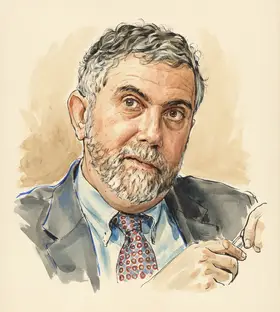
Paul Krugman on Free Trade
Key Points
The economic case for free trade is weakened by the fact that it creates real, localized negative distribution effects on certain workers in import-competing industries.
He strongly dismisses the mercantilist view that trade deficits are a cause for national concern, calling the focus on bilateral deficits "completely ignorant."
In 2025, he argued that recent tariff policies inflicted damage by raising prices, creating uncertainty that froze the job market, and damaging U.S. international credibility.
Summary
Frequently Asked Questions
Paul Krugman is fundamentally a proponent of free trade, viewing it as crucial for global economic growth and a path for poorer nations to develop. He supports the general principle of openness, backed by theoretical models including his own New Trade Theory. However, he does not see it as an unalloyed good, acknowledging its real-world costs.
He strongly disagrees with the idea that tariffs are an effective tool for reducing trade imbalances. Krugman states that, analytically and empirically, tariffs tend to raise the value of a country's currency, which wipes out most of the impact on the trade deficit, except in highly unusual macroeconomic circumstances.
Yes, his intellectual stance has evolved since his 1987 assessment, where he argued free trade had lost its theoretical innocence, shifting from an optimum to a rule of thumb. Recently, he has focused more on the political economy of trade, criticizing the unilateral imposition of tariffs as damaging to global credibility and security.
Sources6
How We Lost the Trade War
Paul Krugman on Trade, Tariffs, & The Role of the United States In the International Macroeconomy
Is Free Trade Passé?
The Move Toward Free Trade Zones
Paul Krugman on The “Trouble With Trade” – International Economic Law and Policy Blog
* This is not an exhaustive list of sources.